
What Happens If My Home Doesn’t Appraise?
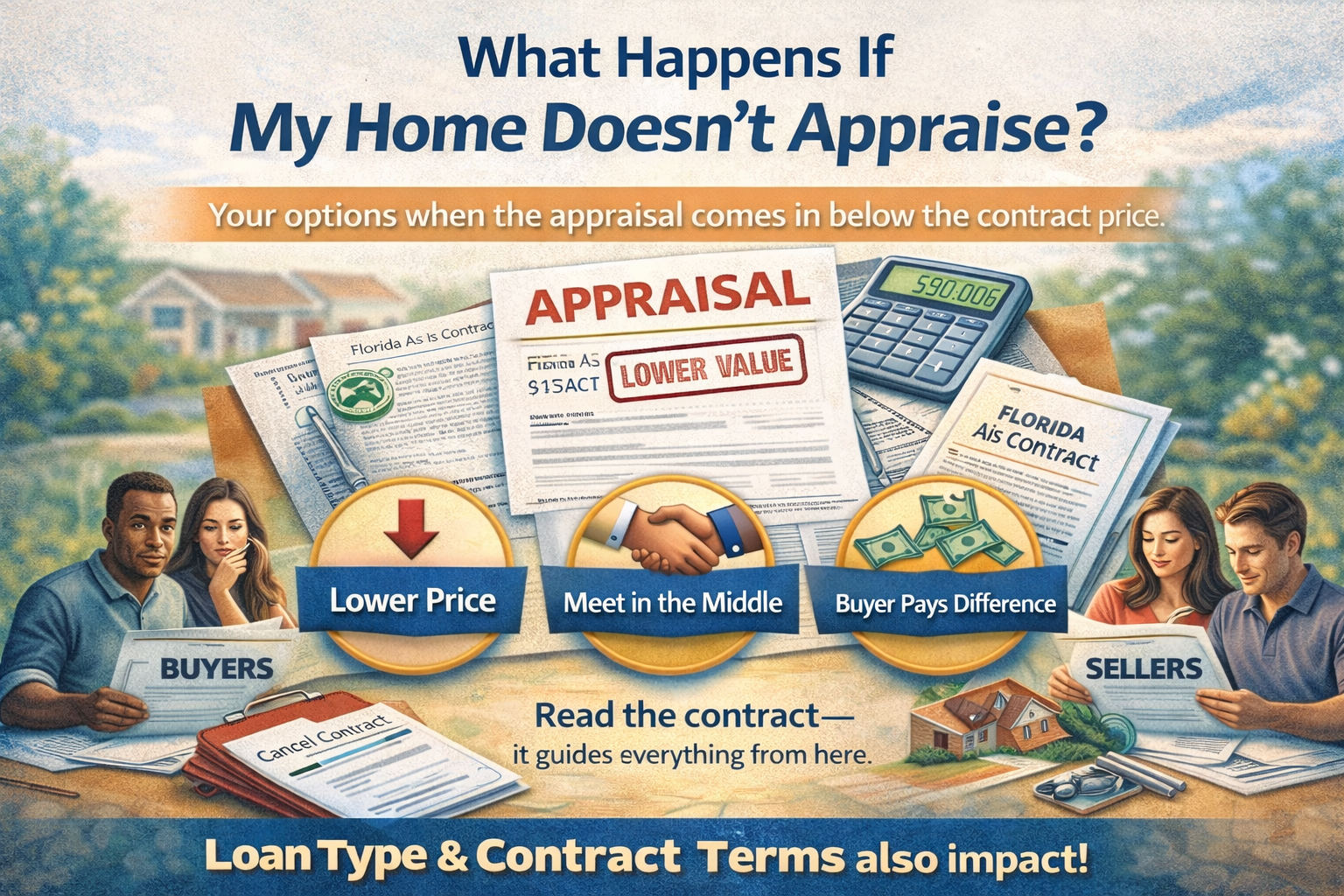
What happens if your home doesn’t appraise after you’re already under contract?
This is one of the most stressful moments for sellers — but the good news is, you usually have options. What happens next depends heavily on your contract, your buyer’s loan type, and the current market conditions.
Let’s walk through it.
Step One: Read the Contract (This Matters Most)
Before anyone panics, the very first thing that needs to happen is this:
👉 Read the contract.
In Northeast Florida, most transactions use either:
The Florida AS-IS Contract
Or the Florida Standard Contract
But buyers can (and often do) add additional terms that change what happens if a home doesn’t appraise.
There is no universal rule — everything flows from what your specific contract says.
What Typically Happens When an Appraisal Comes in Low
As a general overview, when an appraisal comes in below the contract price, there are usually three paths forward:
1. The Seller Drops the Price to Appraised Value
This is often the buyer’s first request.
In today’s market — which leans more buyer-friendly than it did during COVID — most buyers do not want to pay over appraised value.
That desperation we saw during 2020–2022? It’s largely gone.
2. The Buyer Brings the Difference
This means the buyer pays the gap between the appraised value and the contract price out of pocket.
This still happens occasionally — but it’s far less common in today’s market.
3. You Meet Somewhere in the Middle
Sometimes the seller comes down partway, and the buyer brings some additional cash.
This is often where negotiations land if both sides want to keep the deal together.
Appraisal Issues Reopen Negotiations
Here’s something sellers often don’t realize:
If the appraisal comes in low, you’re not limited to only adjusting the price.
You can also say:
“I’ll come down to appraised value, but I’m no longer paying your closing costs.”
“I’ll adjust price, but repairs or credits are off the table.”
“We’re renegotiating the deal as a whole.”
An appraisal issue often reopens all financial terms, not just price.
What If You Can’t Reach an Agreement?
If the buyer has an active financing contingency, and the appraisal issue isn’t resolved, the buyer can typically:
Cancel the contract
Get their binder (earnest money) back
Move on
And you would:
Relist the home
Re-evaluate pricing
Decide how to handle the next buyer
What can’t happen is this:
You can’t force the buyer to pay over appraised value
The buyer can’t force you to lower the price
Unless — and this is key — your contract specifically says otherwise.
Loan Type Matters
The buyer’s loan also plays a role:
Conventional loans have more flexibility
Some loan types are stricter about appraisal gaps
Certain contract addenda may limit renegotiation options
Again — this comes back to knowing what you signed.
Why the Right Realtor Matters Here
This is where experience really shows.
A good agent will:
Understand the contract language
Explain your options clearly
Help you renegotiate strategically
Not immediately default to “you have to drop the price”
If your agent’s response is simply:
“Sorry, you have to lower it to appraised value.”
That’s a problem.
Because most of the time, that’s not automatically true.
Final Takeaway
If your home doesn’t appraise:
Start by reading your contract
Understand what contingencies are still active
Know that you usually have multiple options
And don’t assume price reduction is your only path forward
This is why it’s so important to work with a realtor who truly understands Florida contracts — not just how to write an offer, but how to protect you when things don’t go perfectly.
If you’re selling in Jacksonville, St. Augustine, or anywhere in Duval, Clay, or St. Johns County, CrossView Realty is here to help.
Give us a call at 904-503-0672 or email info@crossviewrealty.com. We’re happy to walk you through your contract, your options, and help you decide the best move forward.