The Housing History of Jacksonville, FL: From River Crossing to River City
Where did Jacksonville’s housing story actually begin — and how did it turn into the city we know today?
Jacksonville didn’t grow all at once.
It grew in waves.
Transportation changed. Fires reshaped it. Bridges expanded it. Highways stretched it. And every time something major shifted, housing shifted with it.
If you’ve ever driven from Springfield to Riverside to Arlington to the Southside and thought, “These don’t even feel like the same city,” you’re not wrong.
They weren’t built at the same time.
They weren’t built for the same reasons.
And they weren’t built for the same kind of lifestyle.
Let’s walk through how Jacksonville housing evolved — and why that still matters today.
It Started at the River
Jacksonville began as a practical place.
Long before it became the largest city by land area in the continental United States, it was a settlement built around a narrow crossing of the St. Johns River. That crossing made trade, travel, and livestock movement easier.
Where people can cross water, towns form.
Early Jacksonville homes clustered near the river and near what would become downtown. The river wasn’t just scenery — it was transportation, business, and survival.
Those early housing patterns were simple and concentrated. Walkable. Compact. Built around necessity.
And then growth began pushing outward.
Railroads and Early Expansion
As Jacksonville became a transportation hub in the late 1800s, the city began expanding beyond its original river-centered footprint.
Railroads and shipping made Jacksonville more connected. More connected meant more people. More people meant more homes.
That’s when some of Jacksonville’s earliest recognizable residential areas started forming outside the tight downtown core.
But the real game-changer for neighborhood growth?
Streetcars.
Streetcars Created Jacksonville’s First “Suburbs”
Before cars dominated everything, streetcars did.
When streetcar lines extended out from downtown, they allowed residents to live farther from the business district while still commuting in easily.
This is how early neighborhoods like Springfield and Riverside gained momentum. Homes were built along routes that made daily life manageable without owning a car.
That’s why some of Jacksonville’s older neighborhoods still feel naturally walkable — because they were designed before highways shaped development.
Porches were bigger. Streets were narrower. Blocks were more compact.
Housing reflected community connection.
The Fire That Changed Everything
Then came one of the most defining moments in Jacksonville’s housing history — the Great Fire of 1901.
A massive fire destroyed much of downtown in a single day. Thousands were displaced. Entire blocks were gone.
And when something like that happens, people don’t just rebuild exactly as before.
Some did rebuild downtown. But many moved outward.
That moment accelerated residential development in areas surrounding the urban core. Neighborhoods that were already forming suddenly became primary housing zones.
The fire didn’t just destroy buildings.
It redirected housing patterns.
Riverside, Avondale, and Architectural Identity
As Jacksonville rebuilt and expanded in the early 1900s, Riverside and Avondale began developing more intentionally.
These neighborhoods weren’t just housing clusters. They had layout plans. Architectural styles. Tree-lined streets.
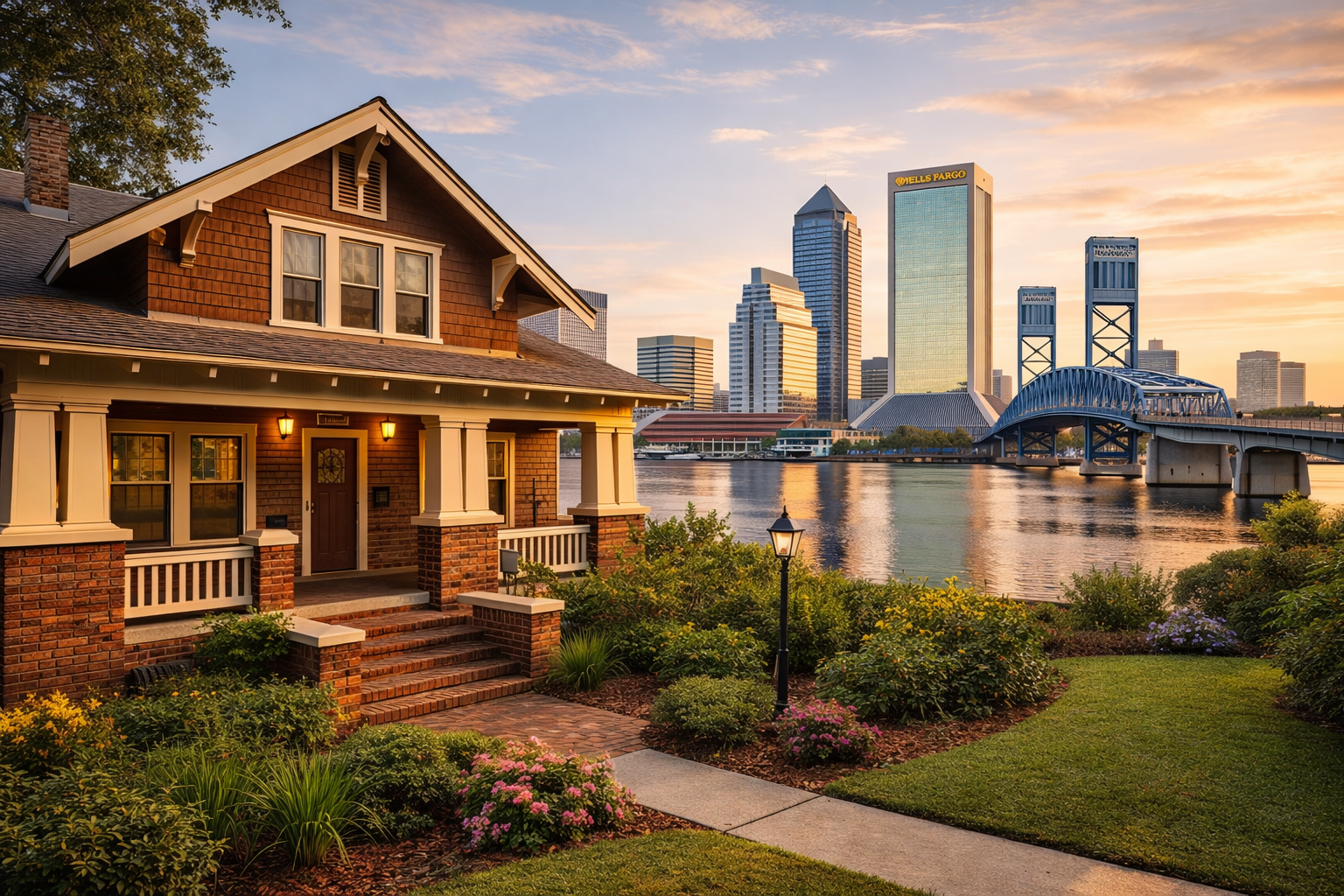
You see a mix of bungalow, colonial revival, Mediterranean influences — homes with personality and craftsmanship.
Even today, those neighborhoods attract buyers who value character and established surroundings.
You don’t get cookie-cutter in Riverside.
You get history.
Springfield: A Window Into Early Residential Jacksonville
Springfield grew rapidly in the late 1800s and early 1900s and became one of Jacksonville’s first large residential neighborhoods outside downtown.
It reflects that era — wood-frame homes, varied architecture, wide front porches, and tight-knit street grids.
When you walk Springfield today, you’re walking through early Jacksonville expansion.
It’s one of the clearest living examples of how the city originally grew.
Bridges and the Southward Push
As infrastructure improved, housing followed.
Bridges across the St. Johns River changed development patterns significantly. Once river crossings became easier and more reliable, areas south of downtown began expanding.
San Marco and surrounding neighborhoods gained traction during this period. What was once a separate municipality eventually became part of Jacksonville’s broader footprint.
When commute time shrinks, development spreads.
It always has.
The Post-War Boom and the Rise of Suburbia
After World War II, Jacksonville experienced the same shift many American cities did — suburban expansion.
Cars were no longer a luxury. Highways expanded. Families wanted space.
Neighborhoods like Arlington grew during this era, shaped by roadway access and automobile convenience rather than streetcar lines.
Homes became more spread out.
Lots got larger.
Garages became standard.
Mid-century ranch homes, cul-de-sacs, and car-centered layouts began defining large portions of Jacksonville housing.
This was a different kind of growth than early Riverside or Springfield.
Less walkable. More spread out.
More suburban.
Consolidation: One City, Many Regions
In 1968, Jacksonville and Duval County consolidated into one unified government. That dramatically expanded the city’s official boundaries.
What does that mean for housing?
It means Jacksonville isn’t just one “type” of city.
It includes urban core neighborhoods. Mid-century suburbs. Waterfront communities. Beach towns. Expanding outer developments.
That’s why housing across Jacksonville feels so varied.
Because it was built across different eras, under different conditions, for different needs.
The Beaches and Coastal Growth
Jacksonville’s coastal communities developed on their own timeline, shaped by tourism, ocean access, and coastal living.
Housing at the Beaches has always reflected a different lifestyle driver than inland neighborhoods.
Smaller cottages. Later, larger coastal homes. Then redevelopment cycles as land values increased.
Proximity to the Atlantic Ocean created its own housing identity separate from the river-focused beginnings of Jacksonville.
Modern Expansion and Master-Planned Communities
In more recent decades, growth has pushed farther outward — especially toward the Southside and into surrounding areas like St. Johns County.
Master-planned communities became more common. Larger developments with amenities, HOA structures, and coordinated design standards began shaping modern housing trends.
This is a very different chapter from Springfield or Riverside.
Less organic. More planned.
And yet, it’s still part of Jacksonville’s evolving housing story.
What Jacksonville’s Housing History Means Today
Jacksonville housing isn’t one thing.
It’s layers.
River-focused beginnings.
Streetcar suburbs.
Post-fire expansion.
Mid-century sprawl.
Coastal growth.
Modern master-planned communities.
That’s why buying here requires more than just looking at square footage and price per foot.
You’re choosing:
An era
A layout philosophy
A lifestyle pattern
A long-term maintenance profile
A home built in 1910 behaves differently than one built in 1975. A home built in 2026 behaves differently than both.
Understanding where Jacksonville came from helps you understand what you’re buying into.
Final Thoughts
Jacksonville didn’t explode overnight.
It expanded gradually — pushed by transportation, shaped by tragedy, and guided by infrastructure.
That’s why it feels like multiple cities woven together.
If you’re buying or selling in Jacksonville, St. Augustine, Orange Park, Fleming Island, Nocatee, Ponte Vedra Beach, Neptune Beach, Atlantic Beach, Jacksonville Beach, St. Johns, Green Cove Springs, or Middleburg, we’d love to help you understand not just the house — but the history behind it.
Give us a call at 904-503-0672, email info@crossviewrealty.com, or visit https://www.crossviewrealty.com/.
Because when you understand the history, you make smarter housing decisions.
Frequently Asked Questions
Q: What is the oldest residential area in Jacksonville?
Some of the oldest surviving residential neighborhoods are near the urban core, including Springfield and Riverside, which saw significant growth in the late 1800s and early 1900s.
Q: How did the Great Fire of 1901 affect housing in Jacksonville?
It destroyed much of downtown and accelerated outward residential growth, reshaping where people chose to live.
Q: Why do some Jacksonville neighborhoods feel more walkable than others?
Older neighborhoods were designed around streetcars and pedestrian travel. Later neighborhoods were built around cars and highways, which changed layout and density.
Q: When did Jacksonville begin expanding into suburban-style communities?
Significant suburban growth occurred after World War II as cars and highway infrastructure became central to development.
Q: Why does Jacksonville feel so large compared to other cities?
City-county consolidation expanded Jacksonville’s footprint dramatically, combining multiple regions and housing types under one city name.