How Much Below Asking Price Should I Offer on a Home?
You found a home you like and you're ready to make an offer — but should you go in below list price, and if so, by how much?
There's no universal answer, and anyone who gives you a blanket number without knowing anything about the home, the market, or the seller's situation is guessing. What there is, is a smarter way to think through it — especially for buyers in Jacksonville, FL and across Northeast Florida right now.
It Starts With the Home, Not a Percentage
The most common mistake buyers make is approaching offer price as a formula — some fixed percentage below list price that feels like a smart opening move. Ten percent below. Fifteen percent. Whatever number feels bold enough to leave room to negotiate.
The problem is that strategy ignores the most important variable: what the home is actually worth relative to its list price.
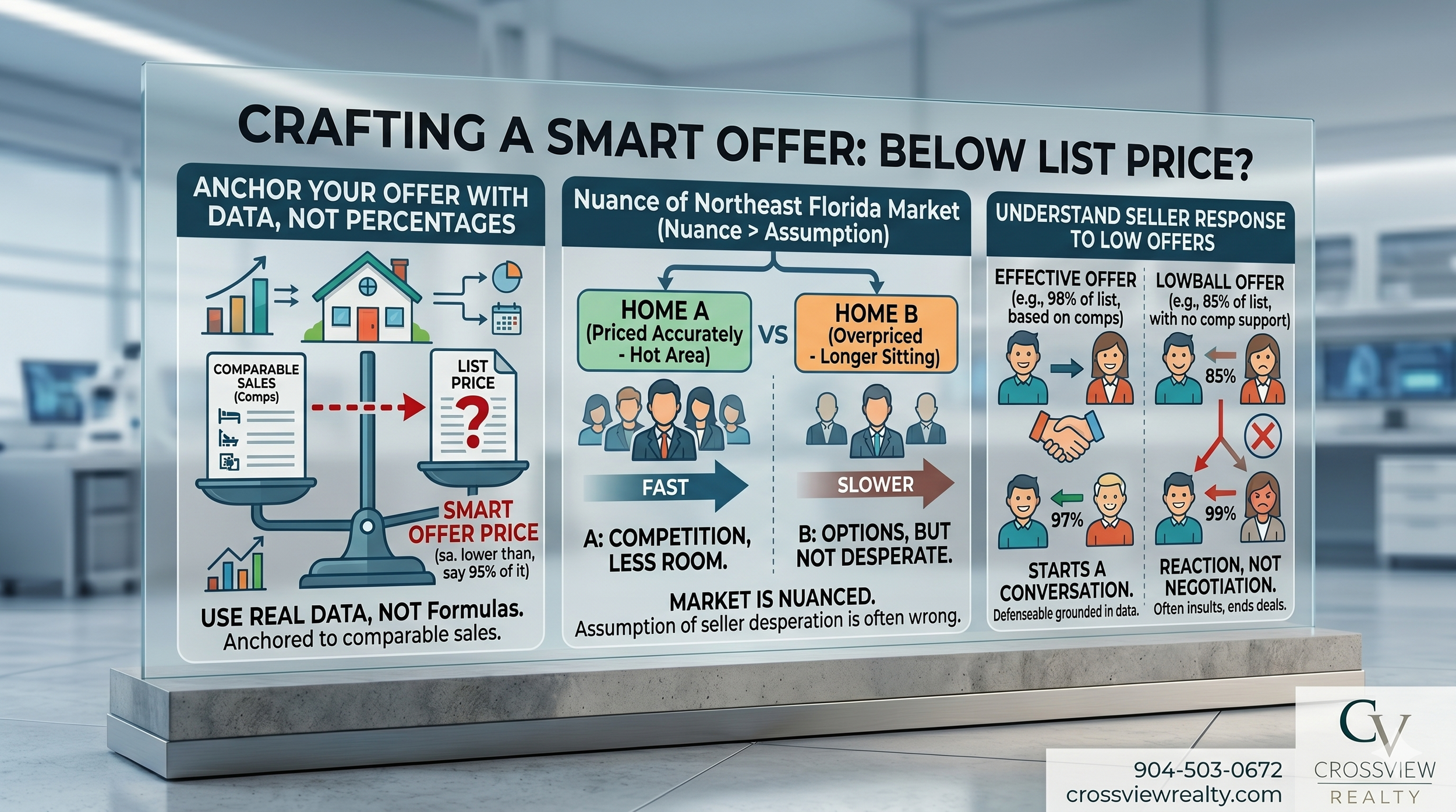
Some homes in Northeast Florida are priced accurately from day one. Others are priced with room to negotiate built in. Some are overpriced by a meaningful margin. And some — particularly well-prepared, well-located homes — are priced right where the market is, and a lowball offer won't get you anywhere except maybe off the seller's list of serious buyers.
Before you decide how much to offer, you need to know what comparable homes have actually sold for recently. That's the data your offer should be anchored to — not the list price, and not a gut feeling about how much wiggle room exists.
What "Below List Price" Actually Looks Like Right Now
The Northeast Florida market in 2026 is nuanced. Some homes are going under contract quickly and still fielding multiple offers. Others have been sitting for 90 days or more. And buyers looking at those longer-sitting homes often assume the seller must be desperate — ready to take anything just to get out.
That assumption is usually wrong.
Sellers who have had their home on the market for an extended period are still receiving offers. Investors reach out on a near-constant basis, making below-market offers on homes across Jacksonville, St. Johns County, Clay County, and Duval. The reason those homes are still sitting isn't that no one is offering — it's that the seller hasn't seen an offer worth taking yet. There's a meaningful difference between a seller who has no options and a seller who has options they don't like.
Coming in with a lowball offer on a home that's been sitting doesn't signal savvy negotiation. It often signals to the seller that you're not serious about their home — and sellers respond to that emotionally, not just logically.
How Sellers Actually Respond to Low Offers
Here's something worth understanding before you write your offer. When a seller receives an offer they feel is insulting — especially after months of investor lowballs — they don't typically respond by meeting you in the middle. They counter close to their list price. Not necessarily because they won't come down further, but because a low offer gets a low counter. It's a reaction, not a negotiation strategy.
That dynamic can kill deals that had real potential. A buyer who genuinely liked the home and had reasonable intentions comes in too low, the seller counters high out of frustration, and both sides walk away from something that could have worked with a more straightforward opening.
If you like a home — even one that's been on the market for a while — the most effective offer is one that reflects what the home is actually worth and what it's worth to you. That's the offer that starts a real conversation.
When Going Below List Price Makes Sense
There are absolutely situations where offering below list price is the right move — and a good buyer's agent will tell you when that is.
If comparable sales in the area support a value that's meaningfully below the list price, your offer should reflect that. If the home has condition issues that affect its market value, that factors in. If the seller has already reduced the price once or twice and comparable data suggests there's still a gap, there's room to negotiate.
The key is that your offer price should be defensible — grounded in real data, not just a number you picked because the home has been sitting. When you can walk a seller through why your number makes sense, it's a negotiation. When you can't, it's an insult.
Work With an Agent Who Knows the Data
In a market as varied as Northeast Florida, the difference between a smart offer and a wasted one often comes down to how well your agent knows the comparable sales. CrossView Realty works with buyers across Jacksonville, Ponte Vedra Beach, St. Augustine, Fleming Island, Nocatee, and throughout the surrounding areas — and we'll tell you honestly what a home is worth before you write a single number down.
That kind of local knowledge protects you from overpaying and from making offers so low they go nowhere.
Ready to make a smart offer on a home in Jacksonville, FL? Give CrossView Realty a call at 904-503-0672, email us at info@crossviewrealty.com, or visit crossviewrealty.com. We'll help you come in with an offer that's competitive, defensible, and gives you the best shot at getting the home you want.
Frequently Asked Questions
Q: How much below asking price should I offer on a home in Jacksonville, FL? It depends on what comparable homes have actually sold for, not on the list price itself. If the home is accurately priced, a significant discount offer is unlikely to go anywhere. If comparable sales support a lower value, your offer should reflect that data. A local agent who knows the market can tell you where the home's price stands before you write anything down.
Q: Is it okay to lowball an offer on a home that's been sitting on the market? It's rarely as effective as buyers expect. Homes that have been on the market in Northeast Florida are still receiving offers — primarily from investors making below-market bids. Sellers who haven't accepted those offers aren't desperate; they're waiting for something reasonable. A lowball offer from a retail buyer often gets a minimal counter or no response at all.
Q: How do sellers respond to low offers in the Jacksonville, FL market? Sellers who feel their home is being undervalued — especially after extended time on market — tend to counter close to their list price rather than meeting a buyer in the middle. It's an emotional response to what feels like an insult. The most productive offers are grounded in comparable sales data and reflect a genuine assessment of what the home is worth.
Q: What's the best strategy for negotiating a home price in Northeast Florida? Anchor your offer to recent comparable sales in the area, account for any condition issues or market factors that affect value, and come in with a number you can defend. That approach starts a real negotiation. A number pulled from thin air — or based purely on how long the home has been listed — usually doesn't.