The Condo Market in Northeast Florida in 2026: What Happened and Where Things Stand
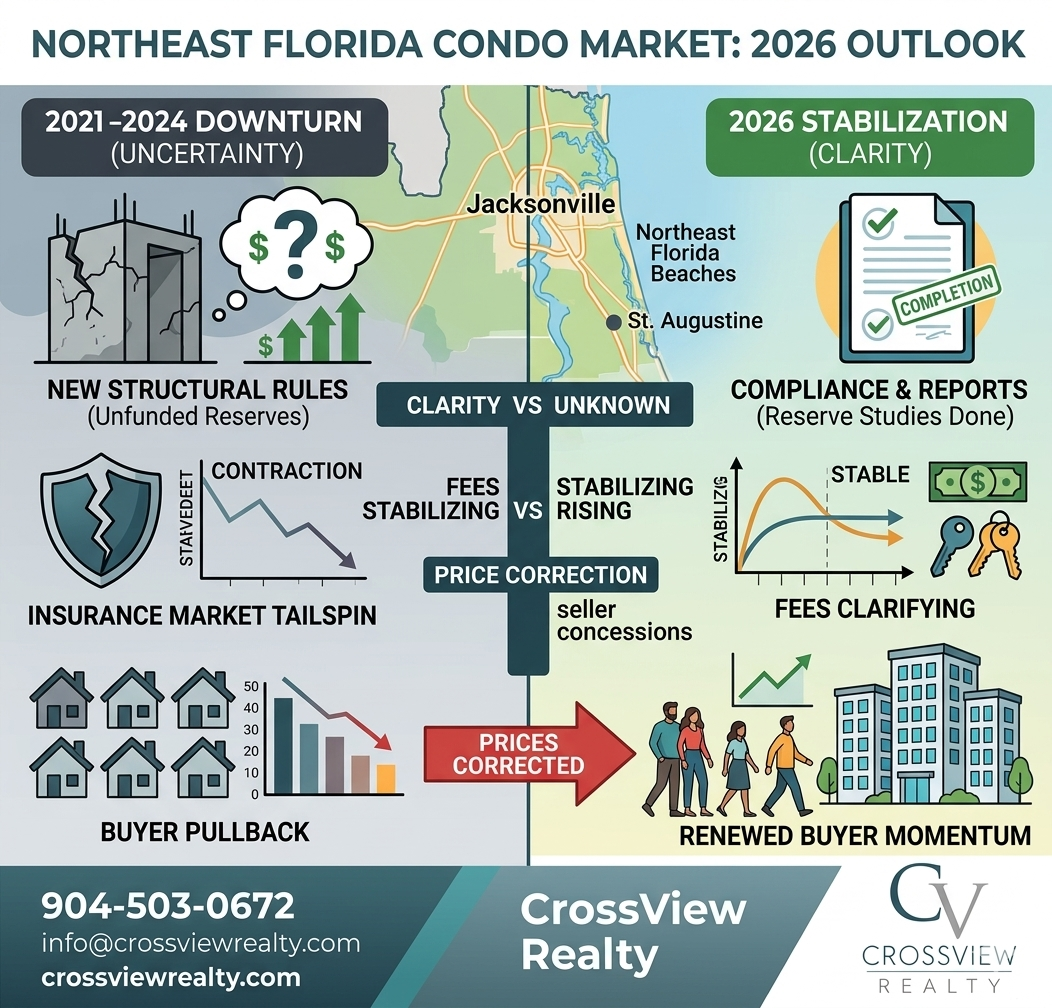
If you've been watching the condo market in Northeast Florida over the last few years, you know it hasn't been pretty. But something has shifted — and buyers and sellers paying attention are starting to take notice.
The condo market across Jacksonville, the Beaches, St. Augustine, and the surrounding communities went through one of its most turbulent stretches in recent memory. Prices dropped. Fees climbed. Buyers disappeared. And a cloud of uncertainty hung over the entire condo sector for long enough that a lot of people simply wrote it off.
That picture is starting to change. Here's what drove the downturn — and why 2026 is looking meaningfully different.
What Sent the Northeast Florida Condo Market Into a Tailspin
Several forces hit the condo market at roughly the same time, and the combination was brutal.
It started with the 2021 collapse of Champlain Towers South in Surfside, Florida — a tragedy that sent shockwaves through the entire state and prompted the Florida Legislature to act. The result was a sweeping set of new requirements for condo buildings three habitable stories and taller, mandating structural integrity reserve studies, milestone inspection reports, and in some cases turnover reports for associations changing hands. Buildings were given deadlines to comply, and the reserves required to fund ongoing maintenance and repairs were significantly increased.
For a lot of condo associations across Northeast Florida, this was a reckoning. Many had been operating with underfunded reserves for years. Suddenly, they were required to catch up — and the cost of that catch-up landed on unit owners in the form of special assessments and sharply higher monthly fees.
The uncertainty around those assessments was its own problem. Buyers considering a condo purchase had no reliable way to know what was coming. Would there be a $10,000 assessment in the next year? A $20,000 one? Nobody could say for certain, and that unknown was enough to push a lot of buyers to the sidelines entirely.
Insurance Made It Worse
Simultaneously, the condo insurance market in Florida was contracting. Carriers that had previously covered condo buildings began pulling back or exiting the market altogether. The ones that stayed recognized they were absorbing a disproportionate share of the risk — and priced accordingly.
Condo association insurance premiums climbed dramatically, and those increases flowed directly into monthly HOA fees. For buyers trying to qualify for a mortgage, higher condo fees reduced purchasing power. A buyer who could have comfortably qualified for a condo at a certain price point found themselves priced out — not because of the purchase price, but because of what the monthly fees added to their debt-to-income ratio.
Some associations, trying to cut costs wherever possible, let their FHA and VA approvals lapse. The reasoning was financial — maintaining those approvals carries administrative costs and requirements. But the consequence was significant. First-time buyers, who disproportionately rely on FHA financing, and veterans using VA loans were suddenly locked out of buildings they previously could have purchased in. That eliminated a major segment of the buyer pool and pushed demand — and prices — further down.
The Insurance Coverage Problem That Created Cash-Only Buildings
There was another insurance issue that hit certain buildings particularly hard. Some associations, in an effort to reduce premium costs, shifted to insurance coverage that didn't meet the requirements lenders need to approve a mortgage. The specific issue involved roof coverage — certain policies that covered the structure but not in the way conventional lenders required.
The result was that some condo buildings in Northeast Florida effectively became cash-only purchases. And when you're selling to a cash-only buyer pool, you're largely selling to investors — and investors buying cash want a deal. Prices in those buildings fell further, and sellers who needed to move faced a difficult choice between holding on and accepting a below-market offer.
What's Different in 2026
Here's where the narrative shifts. After years of uncertainty, the condo market in Northeast Florida is showing signs of genuine stabilization — and in some cases, renewed momentum.
The biggest change is clarity. The structural requirements that created so much fear are no longer unknown quantities for most buildings. Reports have been completed. Assessments have been calculated. And sellers, recognizing that unresolved assessments are deal-killers, have increasingly been willing to cover special assessments at closing to get transactions done. That seller concession has unlocked deals that would have stalled a year or two ago.
Prices have also corrected to a more realistic level. The run-up that made condos feel overpriced relative to their carrying costs has largely unwound. What's left is a market where condos — particularly in the Jacksonville Beaches area, along the St. Augustine waterfront, and in well-maintained inland communities — are priced in a range that's starting to make sense to buyers again.
Condo fees remain elevated in many buildings, and that still puts some units out of reach for buyers with tighter budgets. But the fees are stabilizing. The guessing game around what's coming next has largely been replaced by a clearer picture of what association finances actually look like going forward.
What Buyers and Sellers Should Know Right Now
If you've been sitting out the condo market waiting for things to settle, 2026 may be the year to take another look. Due diligence matters more than ever — understanding a building's reserve funding, its insurance situation, its FHA and VA approval status, and any pending or recent assessments is essential before making an offer. But that information is more accessible now than it's been in several years.
If you're a condo seller in Jacksonville, Neptune Beach, Atlantic Beach, St. Augustine, or anywhere across Northeast Florida, the renewed buyer interest is real — but pricing still has to reflect the reality of the market. Condos that are priced appropriately and have clean association financials are moving. Ones that aren't are still sitting.
CrossView Realty has been working with condo buyers and sellers throughout this entire cycle across Duval, St. Johns, and Clay counties. We know which buildings have gotten their arms around the new requirements and which ones still have question marks — and that knowledge matters when you're making a decision of this size.
Have questions about the condo market in Northeast Florida? Give CrossView Realty a call at 904-503-0672, email us at info@crossviewrealty.com, or visit crossviewrealty.com. Whether you're buying, selling, or just trying to understand what's happening, we're happy to talk it through.
Frequently Asked Questions
Q: Is the condo market recovering in Northeast Florida in 2026? Yes — after several difficult years marked by rising fees, insurance challenges, and uncertainty around structural reserve requirements, the Northeast Florida condo market is showing signs of stabilization. Prices have corrected, assessments are becoming clearer, and buyer interest is returning in communities where association finances are in better shape.
Q: Why did condo fees go up so much in Florida? Two primary factors drove the increase. First, Florida enacted new legislation requiring condo buildings of three habitable stories or more to fund adequate structural reserves and complete milestone inspections — requirements that forced many associations to significantly increase contributions. Second, the Florida condo insurance market contracted sharply, leaving fewer carriers covering more risk at much higher premiums. Both costs flow through to unit owners via monthly HOA fees.
Q: Are condos a good investment in Jacksonville, FL right now? It depends on the specific building and its financial health. Condos in buildings with fully funded reserves, current insurance coverage, active FHA or VA approvals, and resolved special assessments present a much cleaner opportunity than those with outstanding unknowns. Working with an agent who knows the local condo market and can help you evaluate association documents is essential before purchasing.
Q: What is a structural integrity reserve study and why does it matter for condo buyers in Florida? A structural integrity reserve study — sometimes called a SIRS report — is a professionally conducted assessment of a condo building's major structural components and the funding needed to maintain and repair them over time. Florida law now requires these studies for buildings three habitable stories and taller. For buyers, the study reveals whether an association is adequately funded or at risk of special assessments to cover deferred maintenance.
Q: Why are some condos in Florida cash only? Some condo buildings in Florida have insurance coverage that doesn't meet conventional lender requirements — often related to how roof coverage is structured. When a building doesn't meet lender insurance standards, mortgage financing isn't available, which effectively limits buyers to cash purchasers. Cash buyers are predominantly investors seeking below-market prices, which puts downward pressure on values in those buildings.