Florida Condo Fees and Special Assessments Explained
You're looking at a condo in Jacksonville or along the Northeast Florida coast and the monthly fees seem high — or you just heard the word "special assessment" and aren't sure what that means for you.
Both are worth understanding deeply before you buy. Here's a clear breakdown of what's driving condo fees in Florida right now, what a special assessment actually is, and what buyers need to ask before they commit to a purchase.
Why Florida Condo Fees Have Increased So Dramatically
If you've been watching the condo market in Northeast Florida over the last few years, you've likely noticed that monthly HOA fees on many condo buildings have climbed significantly. There are two primary reasons for that — and both stem from events that reshaped the entire Florida condo landscape.
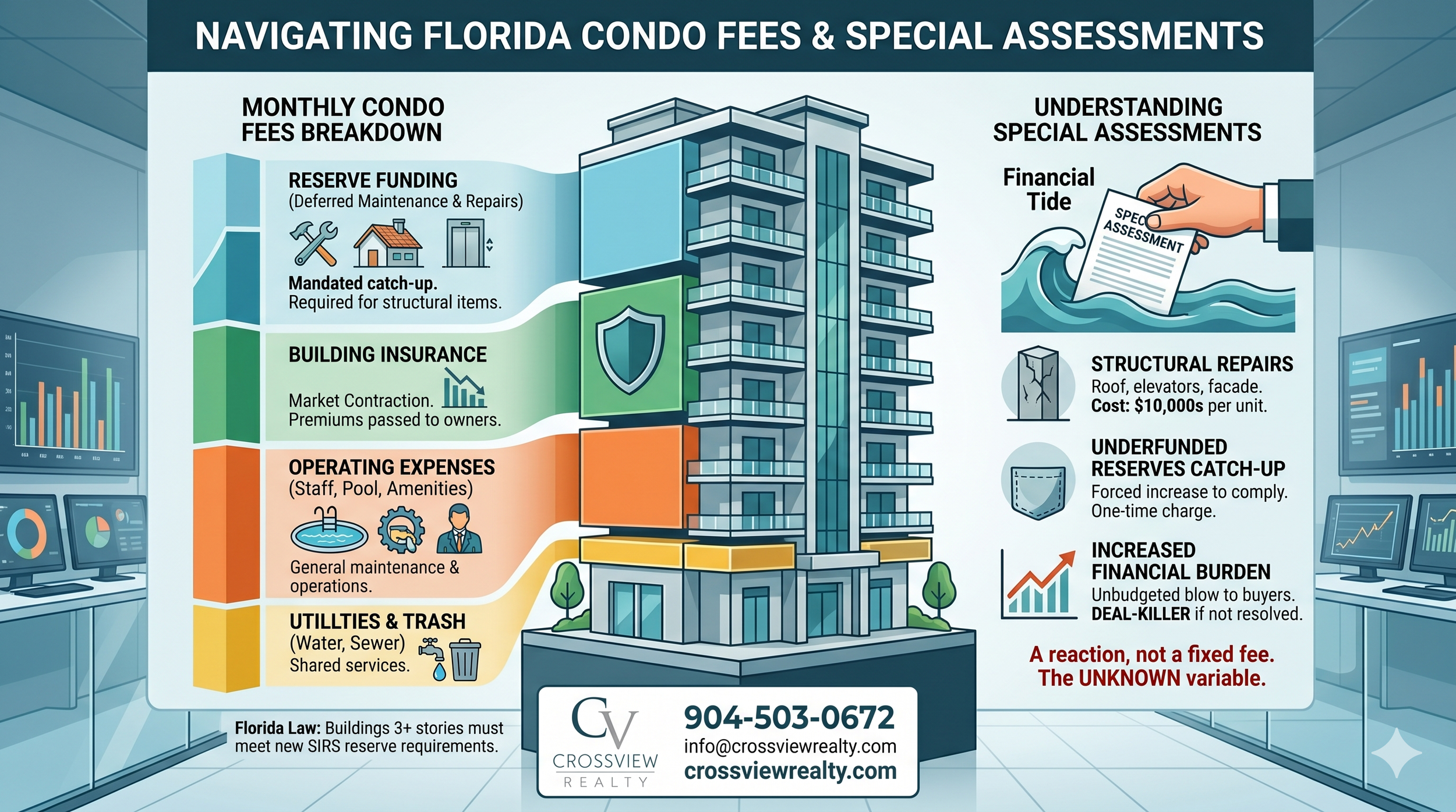
New state reserve requirements. Following the 2021 collapse of Champlain Towers South in Surfside, Florida, the state legislature passed sweeping new laws requiring condo buildings of three habitable stories or taller to meet specific structural reserve funding levels and complete mandatory inspections. Buildings that had been operating with underfunded reserves — which was common — were required to increase their reserve contributions substantially and get current on deferred maintenance. That cost gets passed to unit owners through higher monthly fees.
Insurance market contraction. Simultaneously, the Florida condo insurance market experienced a dramatic pullback. Many carriers stopped writing policies on condo buildings, and the ones that remained priced their coverage to reflect the concentrated risk they were now absorbing. Association insurance premiums rose sharply across Northeast Florida — and those premiums are a direct line item in the budget that determines your monthly condo fee.
Together, these two forces pushed fees higher on buildings across Jacksonville, the Beaches, St. Augustine, and throughout St. Johns and Clay counties — in some cases dramatically so.
What Is a Special Assessment?
A special assessment is a one-time charge levied by a condo association on unit owners to cover a specific expense that the association's regular reserves aren't sufficient to fund. It could be a major repair — a roof replacement, an elevator overhaul, structural remediation — or it could be the cost of catching up on reserve funding requirements that weren't previously met.
Special assessments can range from modest to significant. In the post-Surfside environment, some buildings across Florida have issued assessments in the tens of thousands of dollars per unit to fund required structural work or bring reserves into compliance. For a buyer who purchases a condo without understanding the association's financial picture, an unexpected assessment in the first year of ownership can be a serious financial blow.
This uncertainty — not knowing whether a large assessment was coming — is a significant reason buyer demand for condos in Northeast Florida dropped so sharply over the last several years. The good news is that for many buildings, that picture is becoming clearer as required reports are completed and associations develop defined funding plans.
The Reports Florida Now Requires — and What They Mean for Buyers
Understanding the specific reports now required under Florida law helps buyers ask the right questions during due diligence.
Structural Integrity Reserve Study (SIRS). This is a professionally conducted analysis of a building's major structural and mechanical components — roof, foundation, plumbing, electrical systems, elevators, and more. It calculates the remaining useful life of each component and the funding needed to repair or replace them on schedule. Buildings three habitable stories and taller are now required to have this study completed and to fund reserves accordingly. For buyers, this document reveals whether an association is financially prepared for future maintenance or at risk of special assessments.
Milestone Inspection Report. This is a structural inspection of the building itself, required at the 25-year mark and every 10 years after. It assesses the condition of the building's structural components and flags any repairs needed. If repairs are required, the association must complete them — and fund them, which flows back to unit owners.
When you're purchasing a condo in Florida, requesting these reports as part of your due diligence is essential. An association that has completed its SIRS and milestone inspection, funded its reserves appropriately, and resolved any outstanding assessments is in a fundamentally different position than one that hasn't.
How FHA and VA Approval Affects Your Purchase Options
Here's something many condo buyers don't realize until they're mid-transaction: not every condo building in Northeast Florida is approved for FHA or VA financing. And in recent years, the number of approved buildings has shrunk.
Some associations let their FHA and VA approvals lapse in an effort to reduce administrative costs and compliance requirements. The consequence is that buyers using FHA or VA loans — which includes a large portion of first-time buyers and veterans — cannot purchase in those buildings at all. Only conventional financing or cash is accepted.
Before you fall in love with a specific condo, confirm the building's approval status with your lender. If you're using FHA or VA financing, this step needs to happen early. CrossView Realty can help you navigate this as part of the search process so you're not wasting time on buildings that don't fit your financing.
The Cash-Only Problem — and What It Means for Value
A related issue has emerged in some Northeast Florida condo buildings where insurance coverage doesn't meet conventional lender standards. The specific issue often involves how roof coverage is structured — certain policies that cover the building but not in the way mortgage lenders require. When a building fails to meet lender insurance requirements, financing of any kind becomes unavailable, and the building becomes effectively cash only.
Cash-only buildings have a significantly narrowed buyer pool. The buyers most likely to purchase cash in that environment are investors — and investors buying cash are looking for a deal, not market value. If you own a unit in a cash-only building and need to sell, you're negotiating from a weaker position. If you're considering buying in one, understand that the resale market is constrained until the insurance situation is resolved.
What to Ask Before You Buy a Condo in Northeast Florida
Given everything above, here's what every condo buyer in Jacksonville, St. Augustine, Ponte Vedra Beach, and the surrounding areas should be asking before they make an offer:
What are the current monthly HOA fees, and what do they cover? Have there been any special assessments in the last three years, and are any pending or anticipated? Has the building completed its structural integrity reserve study and milestone inspection? Are reserves adequately funded? Is the building FHA and VA approved? Does the building's insurance meet conventional lender requirements? Is there any litigation involving the association?
These aren't optional questions — they're the foundation of informed condo buying in Florida's current environment. A good buyer's agent will help you get these answers before you're under contract, not after.
Have questions about a specific condo building in Northeast Florida — or want help navigating the condo buying process in Jacksonville, FL? Give CrossView Realty a call at 904-503-0672, email us at info@crossviewrealty.com, or visit crossviewrealty.com. We've worked through this market firsthand and can help you buy smart.
Frequently Asked Questions
Q: Why are Florida condo fees and special assessments so high right now? Two major factors drove increases across the state. New Florida legislation passed after the 2021 Surfside collapse requires condo buildings three stories and taller to fund structural reserves at much higher levels and complete mandatory inspections. Simultaneously, the Florida condo insurance market contracted sharply, pushing premiums dramatically higher. Both costs flow through to unit owners via monthly HOA fees and, in many cases, special assessments to cover underfunded reserves or required repairs.
Q: What is a special assessment on a Florida condo? A special assessment is a one-time charge levied on condo unit owners to cover a specific expense the association's regular reserves aren't sufficient to fund — such as a major structural repair, roof replacement, or reserve catch-up required by new state law. Assessments vary widely in size. Before purchasing any condo in Northeast Florida, ask whether any assessments are pending, anticipated, or have occurred recently.
Q: What is a structural integrity reserve study in Florida and do I need to ask about it? Yes — absolutely. A structural integrity reserve study is a required analysis of a condo building's major structural components and the funding needed to maintain them. It tells you whether the association is financially prepared for future repairs or at risk of issuing special assessments. Requesting this document during due diligence is one of the most important steps a condo buyer in Florida can take.
Q: Can I use FHA or VA financing to buy a condo in Jacksonville, FL? Only if the specific condo building holds active FHA or VA approval. Many buildings in Northeast Florida have let those approvals lapse, which restricts financing to conventional loans or cash only. Confirm approval status with your lender early in the process — before you invest time in a building that doesn't fit your financing type.
Q: How do I know if a condo in Northeast Florida is a good buy given all the fee and assessment issues? Focus on the association's financial health, not just the purchase price. A condo in a building with completed structural reports, adequately funded reserves, resolved assessments, current FHA or VA approval, and proper insurance coverage is in a fundamentally stronger position than one with outstanding unknowns. Working with an agent who knows the local condo market and can help you evaluate association documents before you commit is essential.