
What Is a Pre-Occupancy Agreement?
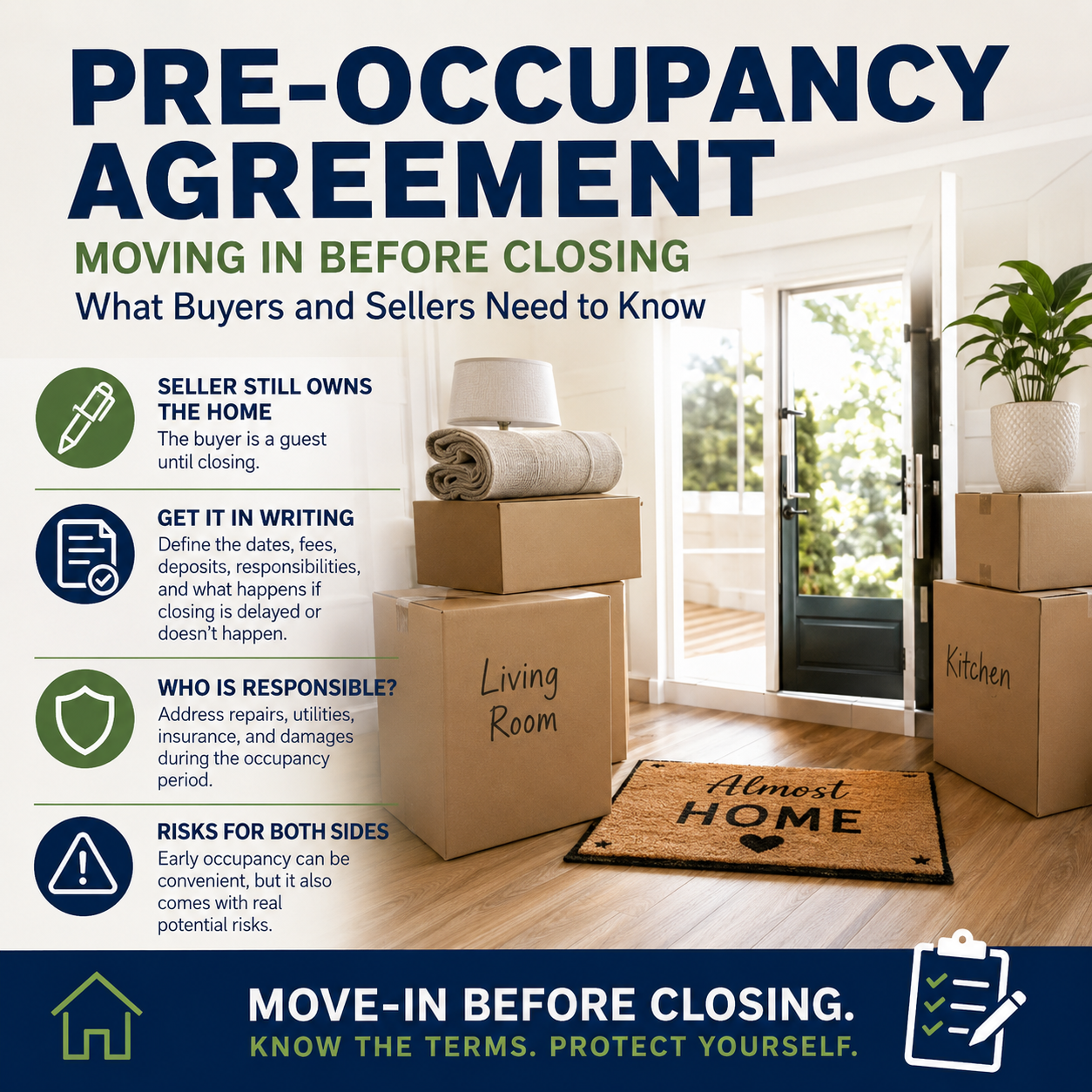
What is a pre-occupancy agreement, and why would a buyer move into a home before closing?
A pre-occupancy agreement allows a buyer to move into a property before the real estate transaction officially closes. Because the seller still owns the home during that time, the arrangement should be carefully documented and treated as a last resort rather than a routine part of the purchase.
How Does a Pre-Occupancy Agreement Work?
In a typical real estate transaction, the buyer receives the keys and takes possession of the home after closing.
The documents are signed. The funds are transferred. Ownership changes hands. Then the buyer moves in.
A pre-occupancy agreement changes that order.
The buyer moves into the home before the closing is complete, which means they are living in a property that still legally belongs to the seller. That might be for one night, a weekend, or a few days while everyone waits for the transaction to close.
And while that can sound like a simple solution, it creates quite a few questions.
Who is responsible for the home during those days? Who pays if something breaks? What happens if the closing never takes place?
Those details matter.
When Might a Buyer Move In Before Closing?
Most of the pre-occupancy situations we see happen because a closing is delayed at the last minute.
Let’s say a home is supposed to close on Friday. The buyer has already scheduled movers, packed the truck, turned in the keys to their rental, and planned to spend the weekend getting settled.
Then something happens.
Maybe a final document is delayed. Maybe a lender needs one more item. Maybe the closing cannot be completed before the office closes for the weekend.
The seller has already moved out, and everyone expects the transaction to close on Monday. So the buyer asks for permission to move in on Friday as originally planned.
That is usually how a pre-occupancy agreement comes up. It is often a last-minute solution to a short-term problem.
But last minute does not mean informal.
A Pre-Occupancy Agreement Should Be in Writing
If a buyer is going to move into the home before closing, there should be a written agreement signed by all parties.
You do not want to rely on a text message, a handshake, or someone saying, “It should be fine. We’re closing Monday.”
The agreement should spell out exactly when the buyer may take possession and what everyone is responsible for during the pre-occupancy period.
Common issues to address include:
The date and time the buyer may move in
The expected closing date
Whether the buyer will pay rent or an occupancy fee
Whether a security deposit will be collected
Who will place the utilities in their name
Who is responsible for maintenance and repairs
What insurance coverage is required
What happens if the buyer damages the property
What happens if the closing is delayed again
What happens if the transaction does not close
How and when the buyer must leave if the sale falls through
These are not fun questions, but they are necessary ones.
Who Is Responsible If Something Breaks?
Let’s say the buyer moves in three days before closing and turns on the electricity in their name.
Then the air conditioner stops working.
The seller still owns the house, but the buyer is living there. So who pays for the repair?
Or maybe the buyer moves furniture into the home and damages a wall. Who handles that?
What if there is a plumbing leak, an appliance stops working, or someone gets hurt on the property?
A well-written pre-occupancy agreement should address responsibility as clearly as possible. The parties should also speak with their real estate professionals, insurance providers, and lender before the buyer takes possession.
You do not want to wait until the air conditioner is not working in July to decide who is supposed to call the repair company.
What Happens If the Buyer’s Loan Does Not Close?
This is one of the biggest risks for the seller.
The buyer has moved into the home, but the sale is not final. Then the loan does not close.
Now the seller still owns the property, but someone else is living in it.
If there is no clear agreement, no security deposit, and no defined process for removing the buyer, the seller may be facing a much more complicated situation than expected.
This is why a pre-occupancy agreement should never be treated casually. Even when everyone believes the closing is only delayed by a day or two, there is always a chance that something else could go wrong.
Real estate transactions do not close until they close.
Is a Pre-Occupancy Agreement Good for the Buyer?
For the buyer, early occupancy can solve an immediate problem.
They may already have movers scheduled. Their current lease may be ending. Their belongings may be loaded onto a truck. They may have children, pets, work schedules, and a dozen other things tied to the planned move-in date.
So yes, being allowed to move in before closing can be a huge relief.
But the buyer also needs to understand that they do not own the home yet.
They may be paying to move into a property that could still fail to close. They may be taking on responsibilities they did not expect. And if the transaction falls apart, they may have to move out quickly after already unpacking.
That is not exactly anyone’s idea of a relaxing moving weekend.
Is a Pre-Occupancy Agreement Good for the Seller?
For the seller, the biggest benefit is usually keeping the transaction moving and helping the buyer through a short delay.
But the seller is also taking on most of the risk.
They still own the home. The buyer is now occupying it. And if the closing does not happen, the seller may have to deal with removing someone from the property, repairing damage, or putting the home back on the market.
That is why many sellers are not comfortable with pre-occupancy agreements, even when the delay appears minor.
It is not personal. It is about protecting the property and understanding what could happen if the transaction does not close as expected.
When Should Pre-Occupancy Be Discussed?
Ideally, any request for a buyer to move in before closing should be discussed at the beginning of the transaction.
If the buyer knows they need early occupancy, that should be part of the offer and contract negotiations. It should not be introduced halfway through the transaction unless a genuine last-minute issue comes up.
The seller may say yes. The seller may say no. Either answer is reasonable.
The important part is having the conversation early, setting expectations, and putting the agreement in writing before the buyer moves anything into the home.
Pre-Occupancy Agreements in Florida Real Estate
A pre-occupancy agreement in Florida should be handled carefully because the seller remains the property owner until closing.
The exact terms will depend on the home, the transaction, the length of the occupancy, and the concerns of both parties. A situation involving one weekend may be handled differently from a buyer asking to move in several weeks early.
Whether you are buying in Jacksonville, St. Augustine, Orange Park, Fleming Island, St. Johns, or another Northeast Florida community, do your research before agreeing to early occupancy.
Know what you are signing. Know who is responsible for what. And know what happens if the closing does not occur.
The Final Takeaway
A pre-occupancy agreement can help when a closing is delayed and a buyer has nowhere else to go. But it should be used carefully, with clear written terms and a full understanding of the risks.
The seller still owns the home until closing, and the buyer is moving into a property they do not own yet. So slow down, ask the uncomfortable questions, and make sure everyone understands the plan before the keys are handed over.
Buying a home in Jacksonville or Northeast Florida? Give CrossView Realty a call at 904-503-0672 to start your home search and talk through the contract terms that may come up along the way. You can also email us at info@crossviewrealty.com or visit CrossView Realty. We’d love to help.
Frequently Asked Questions
Q: What is a pre-occupancy agreement?
A: A pre-occupancy agreement allows a buyer to move into a home before the real estate closing is complete. The seller still owns the property, so the agreement should clearly explain the occupancy period, payment terms, responsibilities, and what happens if the transaction does not close.
Q: Can a buyer move into a home before closing in Florida?
A: A buyer may be allowed to move in before closing if the seller agrees and the arrangement is documented in writing. The buyer, seller, lender, and insurance providers may all have requirements or concerns that need to be addressed before possession is granted.
Q: Does a buyer pay rent under a pre-occupancy agreement?
A: The parties may agree to rent, a daily occupancy fee, a security deposit, or another arrangement. These terms are negotiable, but they should be decided before the buyer moves into the property.
Q: What happens if the buyer moves in and the loan does not close?
A: The buyer may be required to leave the property according to the terms of the agreement. This is one of the biggest risks for the seller, which is why the move-out process and consequences of a failed closing should be addressed in writing.
Q: Is a pre-occupancy agreement a good idea?
A: It may solve a short-term moving problem, especially when a closing is delayed by a few days. But it creates risk for both sides and is generally best treated as a last resort after the parties have reviewed the responsibilities and possible outcomes.