First Coast Expressway: What It Means for NE Florida Homeowners
What does the First Coast Expressway expansion mean for homeowners and commuters in Northeast Florida?
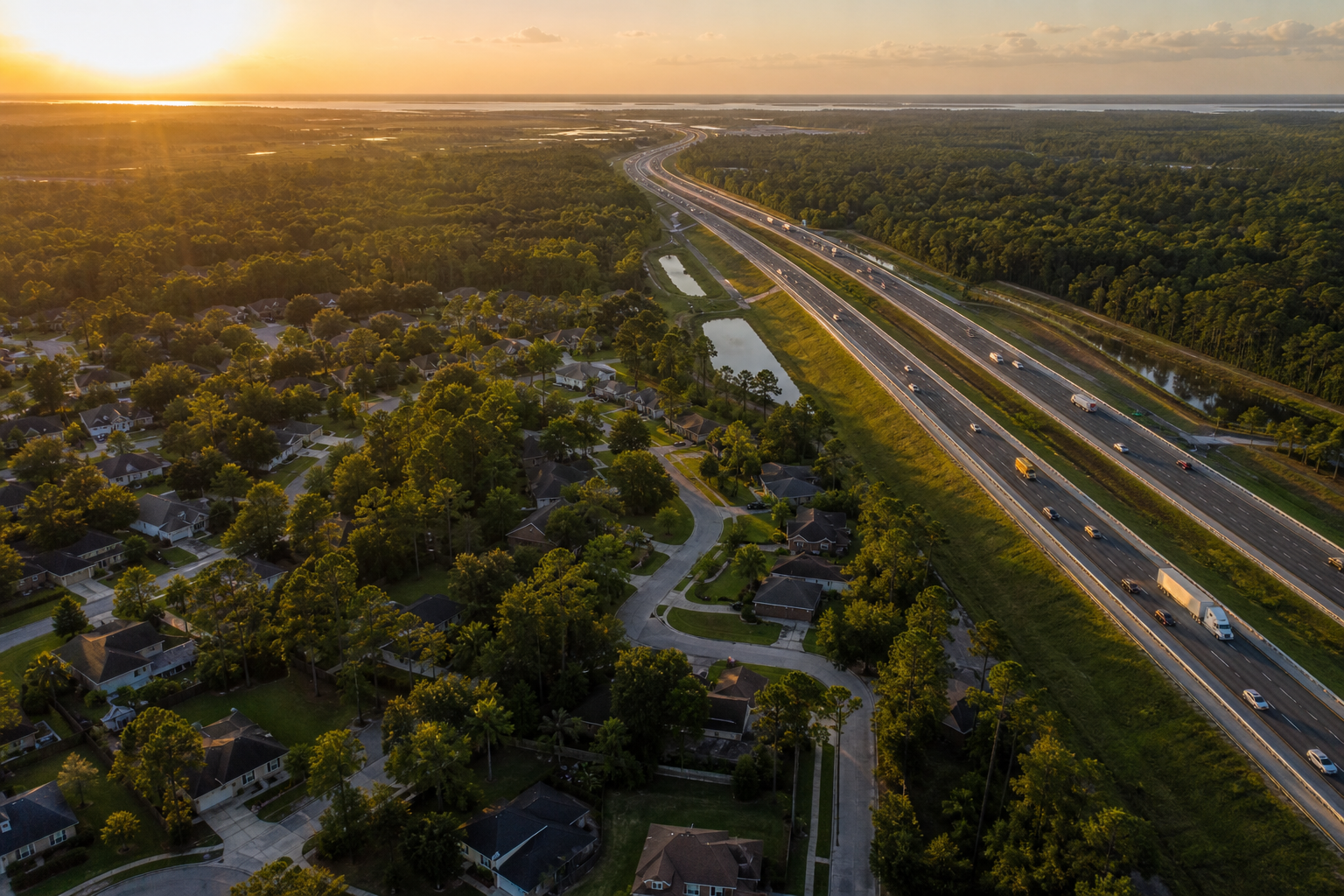
The First Coast Expressway (State Road 23) is a 46-mile limited-access toll corridor being built from I-10 in Duval County through Clay County, across the St. Johns River, and east to I-95 in St. Johns County. As of August 2026, multiple segments are open or under active construction, with the full corridor targeted to open around 2030. For buyers, sellers, and homeowners along this route, the expressway is already reshaping commute patterns, buyer demand, and how properties near the corridor are priced and marketed.
Where Things Stand in August 2026
This project has been years in the making, and it is finally hitting a pace where real change is visible on the ground. Here is what we know as of today.
The segment from I-10 in Jacksonville to State Road 21 (Blanding Blvd) in Clay County has been open for some time, giving Westside commuters a limited-access alternative to the stop-and-go of Blanding Blvd and US-17. According to Choose Clay Economic Development, SR 23 runs roughly parallel to those legacy arterials and ties directly into bedroom communities like Middleburg, Lake Asbury, and Green Cove Springs.
In late June 2026, FDOT opened a new segment in Clay County between US-17 and Leonard C. Taylor Parkway, south of Green Cove Springs. According to Jax Today, tolls began immediately upon opening of this segment. That extension pushes the toll facility closer to the future St. Johns River crossing and gives residents south of Green Cove Springs a more direct link toward Duval County.
Looking ahead, Florida's Turnpike Enterprise lists two active projects on the eastern end of the corridor. One segment east of CR 2209 to east of CR 16A Spur (approximately 1.5 miles) began construction in FY 2025. A second segment from I-95 to east of CR 2209 (approximately 4.5 miles) is scheduled to begin construction in FY 2026. A major bridge over Black Creek near Lake Asbury is under construction and was reported by the Jax Daily Record in June 2026 to be expected complete in late 2026, though construction timelines can shift.
The full corridor, including the new St. Johns River bridge and the eastern connection to I-95, remains targeted to open around 2030, per Action News Jax. That is a planning target, not a guarantee, but as of mid-2026 all remaining phases are reported as fully funded by Florida's Turnpike Enterprise and FDOT, according to the Jacksonville Business Journal. The FDOT work program summary notes over $246 million in Turnpike contributions for the St. Johns River bridge and adjoining segments alone, with $242.6 million allocated for certain Clay County roadway segments. This is a serious, multi-billion-dollar commitment to the corridor.
What the Commute Picture Looks Like Right Now
For residents in Clay County communities like Lake Asbury, Middleburg, and Green Cove Springs, the expressway is already doing some of the work it was designed to do. The limited-access design means fewer traffic signals and higher speed limits compared to Blanding Blvd or US-17. Local coverage from the Jax Daily Record and Action News Jax describes the expressway's purpose as diverting commuter and freight traffic off those congested arterials, shortening drive times between Clay County and Jacksonville job centers.
That said, buyers considering neighborhoods near unopened segments, particularly the future St. Johns River crossing and the I-95 connection in St. Johns County, should understand that the commute benefits they are counting on may not fully materialize until 2030 or later. We always walk buyers through the difference between what a corridor looks like today and what it is projected to look like at completion. Those are two different buying decisions.
What This Means If You Are Buying or Selling Near the Corridor
For Buyers: Demand Is Shifting, But Location Within the Corridor Matters
The expressway is already influencing where buyers look. According to Choose Clay, improved access to I-10 and I-95 is expected to increase the attractiveness of sites in Clay County and western St. Johns County for logistics, manufacturing, and residential development. For homebuyers, that translates to growing interest in new-construction communities along SR 23 as a more affordable alternative to established St. Johns County suburbs, without sacrificing connectivity to Jacksonville.
If you are considering a home near the expressway, here is how we frame the location question with our buyers:
- Proximity to an on-ramp vs. proximity to the road itself. Being a short drive from an interchange is different from backing up to an elevated section. Properties very close to interchanges can offer faster access but also higher traffic noise. We always recommend visiting at different times of day before making an offer.
- Phased openings mean phased benefits. If the segment nearest your target neighborhood is still under construction, factor in what the commute looks like today, not just at full build-out.
- New construction communities along SR 23 are actively marketing expressway access as a feature. If you are exploring those options, make sure you have your own representation from day one. The builder's sales agent works for the builder, and understanding what you are actually buying relative to the expressway corridor takes independent guidance. Our post on new homes for sale in Green Cove Springs covers some of these dynamics in detail.
Recent Zillow market data shows the broader area is active. St. Johns County is seeing a median sale price of $535,000 with homes going under contract in a median of 19 days, based on trailing 90-day figures as of August 2026. That is an area-level figure; an individual home's value depends on condition, street, build year, and timing. Here is a snapshot of how a few key Northeast Florida markets compare right now:
| Area | Median Sale Price | Median Days on Market |
|---|---|---|
| St. Johns | $555,000 | 26 |
| Ponte Vedra Beach | $900,000 | 43 |
| Jacksonville Beach | $655,000 | 53 |
Source: Zillow sales data, trailing ~90 days, as of August 2026. Area-level medians only; individual home values vary.
For Sellers: Disclosure and Timing Are the Two Big Questions
If you are selling a home near the First Coast Expressway corridor, two things matter more than anything else: what you disclose and when you list.
On disclosure: Florida sellers are legally obligated to disclose known material defects and facts that are not readily observable, a standard established under Florida case law. In practice, most Jacksonville-area transactions use a standard Seller's Property Disclosure form, typically a Florida Realtors form, to document known property conditions. For homes near the expressway, that means disclosing any known information about planned construction, easements, or future right-of-way impacts. This is not optional, and it is also in your interest. A buyer who discovers a construction issue after closing is a problem; a buyer who understood the corridor context going in is not.
On timing: Some sellers near active construction zones try to list either before major noise or disruption peaks, or after a new segment opens and accessibility improves. The June 2026 Clay County opening is a real example of an event that changes the narrative around nearby listings. We watch FDOT construction calendars and opening announcements closely when advising sellers on timing, because that context affects how buyers perceive the home and how quickly it moves.
Broker compensation is fully negotiable and not set by law. There is no standard or fixed rate, and any compensation arrangement is set in your listing agreement. If you want to understand what selling near this corridor looks like for your specific property, the right move is a conversation, not a formula.
Your specific situation depends on where you are in relation to the corridor, what construction activity looks like near your address, and what the market is doing in your submarket right now. That is exactly the kind of question we walk our clients through before we ever put a sign in the yard. Get a home valuation to start that conversation.
If you have read reviews from other buyers and sellers in Northeast Florida, we invite you to see what our clients say about working with CrossView Realty on Google, Zillow, and Realtor.com.
Frequently Asked Questions
When will the First Coast Expressway be fully open, and which segments are already open as of 2026?
As of August 2026, the segment from I-10 in Duval County to SR 21 in Clay County has been open for some time, and a new segment between US-17 and Leonard C. Taylor Parkway south of Green Cove Springs opened in late June 2026. Construction is active on segments approaching I-95 in St. Johns County. The full 46-mile corridor from I-10 to I-95 is targeted to open around 2030, per FDOT, though that is a planning target subject to change.
How will the expressway change commute times from Clay County neighborhoods like Lake Asbury or Green Cove Springs to Jacksonville?
The expressway is designed to give commuters a limited-access alternative to congested arterials like Blanding Blvd and US-17, with fewer traffic signals and higher speed limits. The June 2026 segment opening already extends that benefit south of Green Cove Springs. Full commute relief for the entire Clay-to-Jacksonville corridor will phase in as additional segments open through 2030. Buyers targeting neighborhoods near unopened segments should factor in what the drive looks like today, not just at full build-out.
Is the First Coast Expressway a toll road, and how are tolls collected?
Yes, SR 23 is a toll road operated by Florida's Turnpike Enterprise. Tolls began immediately upon the June 2026 Clay County segment opening, per Jax Today. Florida's Turnpike system uses all-electronic tolling, meaning SunPass transponders or license-plate-based billing (Toll-By-Plate) rather than traditional toll booths. Daily commuters who use the expressway regularly will want to factor toll costs into their overall commute budget.
Will the new bridges and improved access increase property values near the expressway, or will noise offset the benefit?
The honest answer is: it depends on the specific location. Properties close to interchanges or elevated sections can experience higher traffic noise, while homes a short drive from an on-ramp often capture the commute benefit without the noise exposure. Local economic-development groups and the Jacksonville Business Journal frame the corridor as a driver of long-term land value growth in Clay and western St. Johns County, but there is no published, quantified premium specific to expressway adjacency in Northeast Florida as of August 2026. We recommend visiting any property near the corridor at multiple times of day before making a decision.
When selling a home near the First Coast Expressway, what do I need to disclose about road noise or construction?
Florida sellers are legally obligated to disclose known material facts that are not readily observable, under established Florida case law. For homes near the expressway, that includes known information about planned construction activity, easements, or future right-of-way impacts. Most Jacksonville-area brokerages use a standard Seller's Property Disclosure form to capture this information. Disclosing what you know up front protects you from disputes after closing and gives buyers the context they need to make an informed offer.
Could better access to I-10 and I-95 shift buyer demand toward communities along SR 23 in Clay and western St. Johns County?
It already is. Clay County communities like Lake Asbury, Middleburg, and Green Cove Springs are increasingly positioned as more affordable alternatives to established St. Johns County suburbs, with the expressway as a key selling point for new-construction communities along the corridor. As additional segments open through 2030, that demand shift is likely to continue. Buyers who get into those markets before full build-out may benefit from improving accessibility over time, but commute conditions today will differ from what the corridor looks like at completion.
The First Coast Expressway is one of the most consequential infrastructure projects in Northeast Florida's recent history, and it is already changing how buyers think about Clay and St. Johns County. Whether you are buying near the corridor, selling a home with construction activity nearby, or just trying to understand what this means for your commute and your home's value, we are here to walk you through it. Reach out to CrossView Realty and let's talk through your specific situation.
Equal Housing Opportunity. CrossView Realty, Brokerage License CQ1051941, licensed by the Florida Real Estate Commission. This article is general information only and does not constitute legal, tax, or financial advice. Verify your specific numbers and circumstances with your attorney, tax advisor, lender, or closing officer before making real estate decisions.