What St. Augustine Buyers Should Consider About Waterfront Living
What St. Augustine Buyers Should Consider About Waterfront Living
What should St. Augustine buyers consider about waterfront living before making an offer?
St. Augustine buyers should consider flood zone designation, flood insurance costs, elevation certificates, and dock permitting rights before purchasing any waterfront property. These factors directly affect your financing options, annual carrying costs, and what you can legally build or maintain on the water, and none of them show up in the listing photos.
Key Takeaways
Recent local market data shows the St. Augustine area median sale price at $540,000, with homes selling in a median of 49 days, waterfront properties often carry a significant premium above that baseline.
FEMA's Flood Insurance Study for St. Johns County distinguishes Special Flood Hazard Areas (zones A, AE, V, and VE) from lower-risk zones, your specific parcel's designation drives your insurance requirement and cost.
An Elevation Certificate is one of the most important documents in a waterfront transaction; it tells you how a home sits relative to the base flood elevation and directly influences what you'll pay for flood insurance.
Buying a waterfront home does not automatically convey the right to build, repair, or maintain a dock, dock feasibility depends on the parcel, submerged-land ownership, environmental restrictions, and permits from local, state, and federal agencies.
Waterfront conditions vary substantially across St. Augustine, a home on an inland canal, the Matanzas River, the Intracoastal Waterway, or an ocean-facing shoreline each carries a different combination of surge risk, wave action, and permitting constraints.
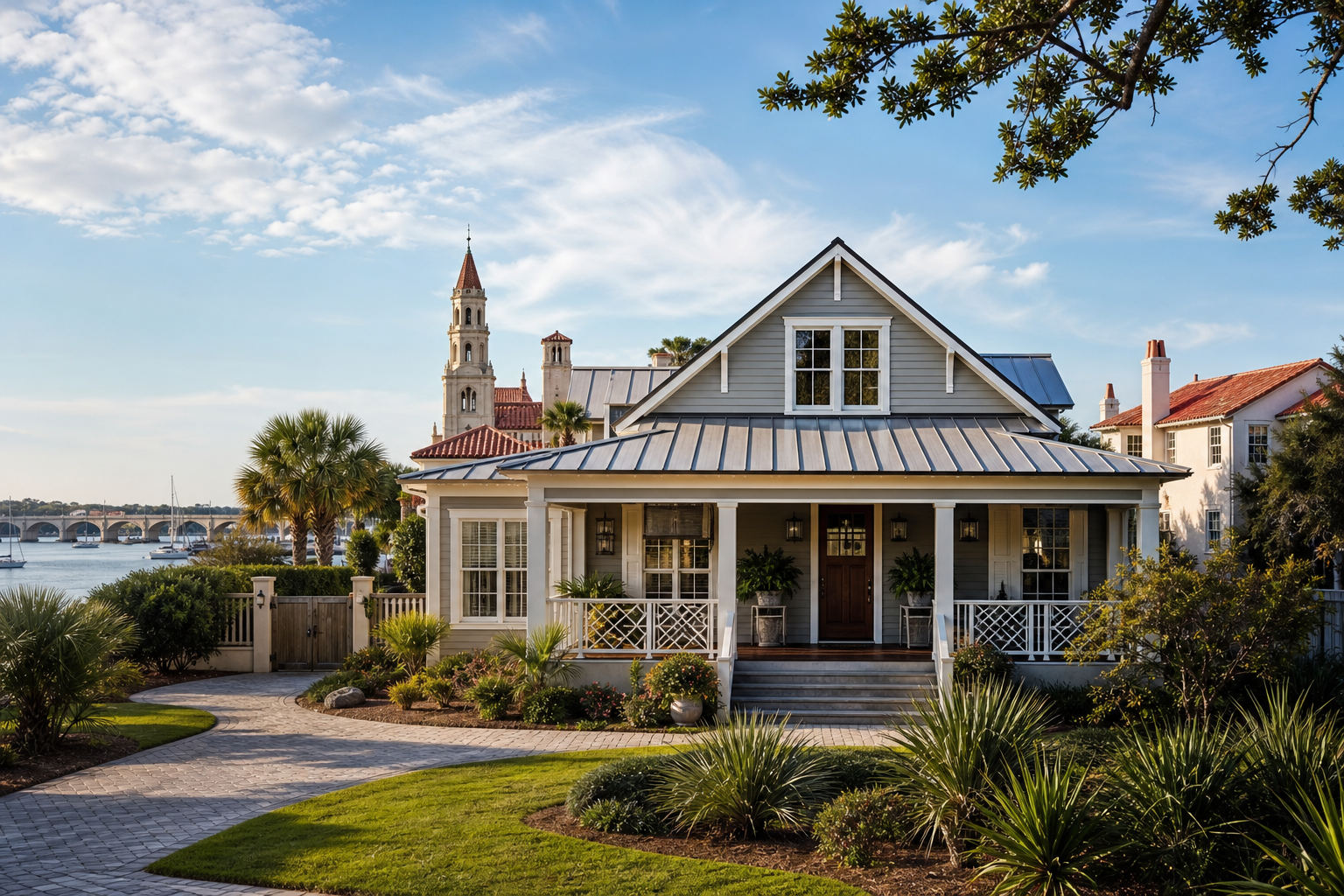
The view is stunning. The sunsets are real. And yes, waking up on the water in St. Augustine is every bit as good as it sounds. But here's what we tell every buyer who asks us about waterfront living: the view is the easy part. The due diligence is where the real work happens, and it's what St. Augustine buyers should consider carefully before falling in love with a listing.
We've walked a lot of clients through waterfront purchases in Northeast Florida. The ones who feel great about their decision months later are the ones who understood flood zones, insurance, and dock rights before they made an offer. The ones who didn't? They sometimes had expensive surprises waiting for them at closing, or after.
So let's walk through it.
What do flood zones actually mean for St. Augustine buyers?
Flood zone designation is one of the first things St. Augustine buyers should consider when evaluating any waterfront home. It determines whether flood insurance is required, how much it costs, and how a lender will treat the property.
According to the FEMA Flood Insurance Study for St. Johns County, FEMA distinguishes between the 1% annual-chance floodplain (commonly called the 100-year floodplain) and the 0.2% annual-chance floodplain (the 500-year floodplain). Flood zones A, AE, V, and VE are all examples of Special Flood Hazard Areas (SFHAs). If a property sits in one of these zones and carries a federally backed mortgage, flood insurance through the National Flood Insurance Program is required by the lender, no exceptions.
But here's the thing: even if your lender doesn't require it, that doesn't mean you don't need it. We always encourage buyers to look at what flood insurance would cost regardless of whether it's mandatory. A home just outside a mapped SFHA can still flood, and without coverage, that's entirely out-of-pocket.
You can look up any property's official flood zone designation through the FEMA Flood Map Service Center. It's a free tool, and it's one of the first things we pull up when we're evaluating a waterfront listing with a client.
What is an Elevation Certificate and why does it matter?
An Elevation Certificate is a document that records how a structure sits relative to the Base Flood Elevation (BFE) for its flood zone. Insurance companies use it to calculate your premium, and the difference between a home that sits one foot below BFE versus two feet above it can be thousands of dollars a year in insurance costs.
If a seller has an existing Elevation Certificate, ask for it early. If one doesn't exist, you may want to order one as part of your due diligence. FEMA's Elevation Certificate guidance explains what the document covers and who can prepare one (it must be a licensed surveyor, engineer, or architect).
This is one of those details that can meaningfully change the math on a waterfront purchase. Your specific number depends on the home's location, construction, and elevation, that's exactly the kind of thing we work through with our clients before they make an offer.
NFIP vs. private flood insurance: what's the difference?
The National Flood Insurance Program is the most common source of flood coverage for waterfront homes, but it isn't the only one. Private flood insurance has grown significantly in Florida, and in some cases it offers higher coverage limits or more competitive pricing than the NFIP. FloodSmart.gov is a good starting point for comparing your options.
We always tell buyers to get flood insurance quotes early in the process, not at the end. It's a carrying cost that belongs in your budget from day one.
What St. Augustine buyers should consider about dock rights and waterfront structures
This is the part that surprises people most. A waterfront address does not automatically mean you have the right to build a dock, replace an existing one, or even maintain the one that's already there.
Dock feasibility in St. Augustine depends on a combination of factors: the recorded property boundary, whether submerged lands are privately owned or state-owned, any recorded easements, environmental restrictions, the navigability of the water body, and permits from local, state, and federal agencies. The Florida Department of Environmental Protection oversees submerged lands and environmental resource permitting for dock construction in Florida, and their process is separate from anything at the county level.
Here's what we recommend treating as a checklist on any waterfront property with a dock:
Confirm the recorded property boundary and whether any submerged-land or riparian rights are included in the deed.
Verify existing permits for the dock, its dimensions, and any boat lift or electrical equipment, and confirm whether those permits are transferable to a new owner.
Check the condition of pilings, decking, and any mechanical components. A dock inspection is separate from a home inspection.
Identify whether the dock is fixed or floating, they carry different permitting requirements.
Confirm local permit records through St. Johns County Building Services and cross-reference with the parcel data at the St. Johns County official site.
If you're buying a home without a dock and hoping to add one, get that feasibility question answered before you close, not after. We've seen buyers purchase a waterfront lot only to discover that the shoreline conditions, environmental buffers, or submerged-land ownership made a dock impossible or prohibitively expensive to permit.
Not all St. Augustine waterfront is the same
This matters more than most buyers expect. A home on a quiet inland canal in Fruit Cove faces a very different set of conditions than a home on the Intracoastal Waterway near Ponte Vedra Beach, or an ocean-facing property near the coast, or a home on the Matanzas River closer to downtown St. Augustine. Surge exposure, wave action, erosion rates, navigation rules, and permitting constraints all vary by the specific water body, not just the city or ZIP code.
That's why the analysis has to be parcel-specific. A flood zone map for a ZIP code tells you very little about the house on the corner lot at the end of a tidal creek. We look at the specific address, the specific water body, and the specific structure, every time.
For buyers considering higher-end coastal properties, our post on Buying a Luxury Home in Northeast Florida covers additional due diligence considerations at that price point.
How does the St. Augustine market look for waterfront buyers right now?
Recent local market data shows the St. Augustine area median sale price at $540,000, with a median of 49 days on market, a pace that leaves little room for slow decision-making. Waterfront properties typically carry a meaningful premium above the area median, and the combination of limited inventory and strong demand means well-priced waterfront homes move quickly.
Here's a look at how median sale prices compare across the Northeast Florida areas we serve:
Area - Median Sale Price - Median Days on Market
Jacksonville - $320,990 - 28
Fruit Cove - $599,000 - 22
St. Augustine - $540,000 - 49
Ponte Vedra Beach - $1,297,500 - 26
Jacksonville Beach - $757,500 - 19
Neptune Beach - $817,500 - 17
These are area-level medians from recent local market data. An individual waterfront home's value depends on its specific location, water body, condition, flood zone, and what structures (like a dock or seawall) are included. The National Association of REALTORS® consistently shows that waterfront premiums vary widely based on these exact factors, which is why a local market analysis matters more than a Zestimate on a waterfront purchase.
If you're newer to the buying process and want to get grounded before diving into waterfront specifics, our First-Time Buyer Guide: St. Augustine FL is a good place to start.
The pace in St. Augustine right now means you need your due diligence framework ready before you find the house, not while you're in contract and racing a clock. Flood zone research, insurance quotes, and dock permit verification all take time. We help our clients get that groundwork done early so they can move confidently when the right property comes up.
If you're serious about waterfront living in St. Augustine, let's talk through what that looks like for your specific situation. Reach out to us at CrossView Realty, we'd love to help you find the right property with eyes wide open. Or if you already have a property in mind, get a home valuation to understand what you're working with.
We'd love to hear what you think of our work. Feel free to read our reviews on Google, Zillow, or Realtor.com.
Frequently Asked Questions
Is a St. Augustine waterfront property automatically in a FEMA flood zone?
Not automatically, but many are. FEMA maps flood zones by specific parcel and elevation, not just proximity to water. You should look up the exact address on the FEMA Flood Map Service Center to confirm the designation before making an offer. A property in zones A, AE, V, or VE is in a Special Flood Hazard Area, which affects both insurance requirements and financing.
Do I need flood insurance even if my lender doesn't require it?
In most cases, yes, it's worth carrying even when it isn't mandatory. Properties just outside a mapped Special Flood Hazard Area can still experience flooding, and without coverage, any damage is entirely out-of-pocket. We recommend getting flood insurance quotes early in your search so the annual cost is built into your budget from the start, not discovered at closing.
What does an Elevation Certificate tell me about a waterfront home?
An Elevation Certificate records how the structure sits relative to the Base Flood Elevation for its flood zone, and insurance companies use it to calculate your premium. A home that sits well above the BFE typically costs less to insure than one that sits at or below it. If the seller doesn't have one, you can order it from a licensed surveyor, and the cost is often worth it given the impact on your long-term insurance expenses.
Does buying a waterfront home automatically include dock rights?
No. A waterfront address does not automatically convey the right to build, maintain, or replace a dock. Dock feasibility depends on the recorded property boundary, submerged-land ownership, environmental restrictions, and permits from local, state, and federal agencies, including the Florida Department of Environmental Protection. Always verify dock rights and existing permits as a separate line item in your due diligence.
What should I inspect besides the house when buying on the Intracoastal or near the coast?
Beyond the standard home inspection, waterfront buyers should separately evaluate the dock (pilings, decking, boat lift, electrical), seawall condition and any erosion, flood zone and elevation, storm-surge exposure for the specific water body, and the permit history for all waterfront structures. Each of these can carry its own costs and complications, and a standard home inspector may not cover all of them, ask specifically about waterfront structure inspections when you're vetting inspectors.
About Jennifer Hendry
Jennifer Hendry is the Broker/Steward of CrossView Realty, an independent brokerage based in Jacksonville, Florida, serving buyers and sellers throughout Northeast Florida. She leads a team of trusted real estate professionals dedicated to guiding clients through luxury, waterfront, relocation, military, and first-time buyer transactions with integrity and client-first care.
CrossView Realty · (904) 503-0672
Equal Housing Opportunity. CrossView Realty, Brokerage License CQ1051941, licensed by the Florida Real Estate Commission. This article is general information only and is not legal, tax, or financial advice. Confirm your specific costs, flood zone, insurance requirements, and permit status with your title company, tax advisor, lender, or the relevant permitting authority.