
How to Choose a Mortgage Lender Before Buying a Home
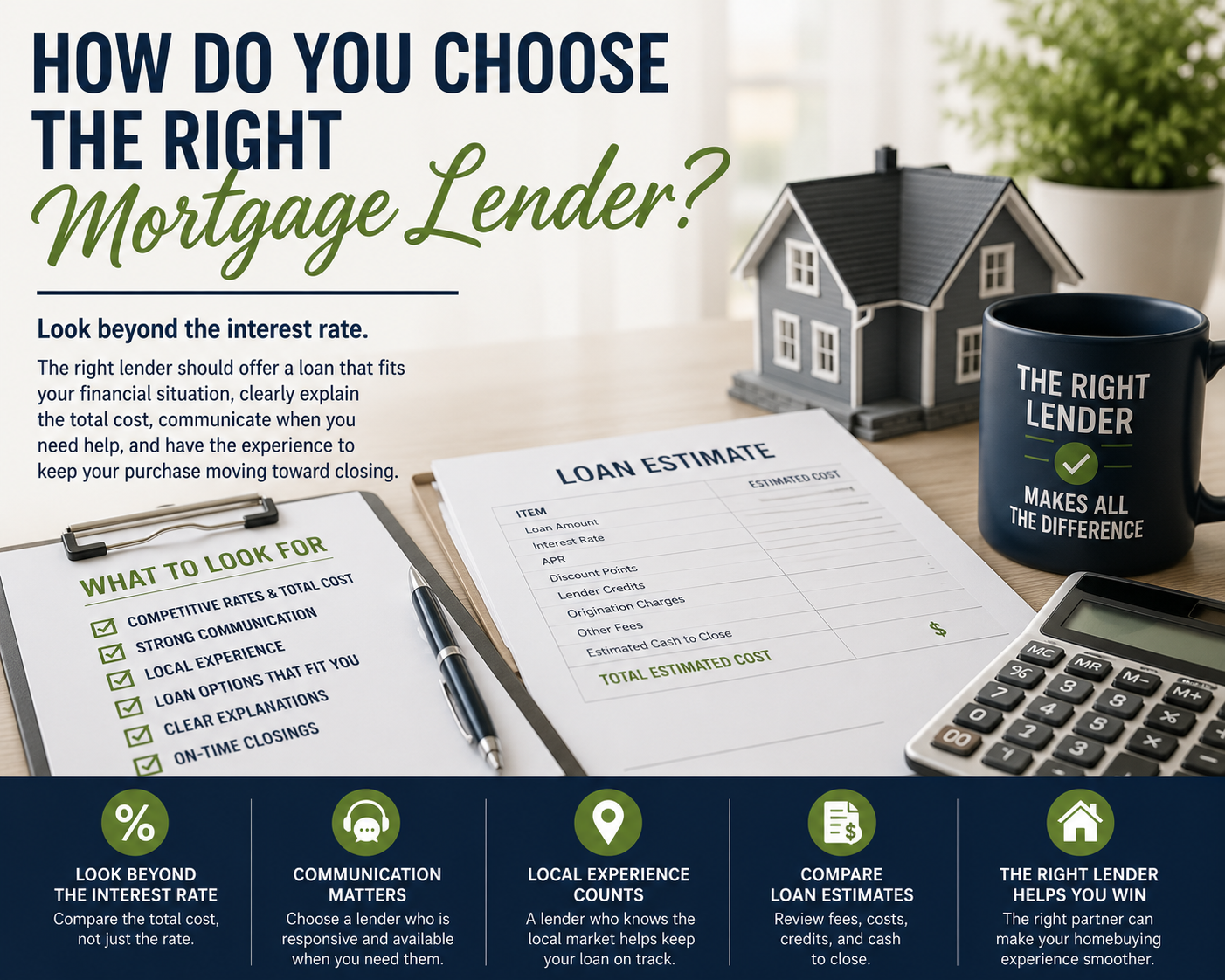
How do you choose the right mortgage lender when there are so many options?
Look beyond the advertised interest rate. The right lender should offer a loan that fits your financial situation, clearly explain the total cost, communicate when you need help, and have the experience to keep your purchase moving toward closing.
A lot of buyers begin with the bank they already use.
And that makes sense.
You already have an account there. They have some of your information. Maybe you have been banking with them for years, so it feels like the easiest place to start.
But here’s the deal: using your current bank does not necessarily mean the mortgage process will require less work.
You should still expect to provide financial documentation. Depending on your loan and circumstances, that may include pay stubs, bank statements, tax returns, identification, employment information, and explanations for certain deposits or financial activity.
Your mortgage application must still go through verification and underwriting.
So, before automatically choosing your bank, take a little time to compare your options.
How to Choose a Mortgage Lender Based on Service
Interest rates matter.
Of course they do.
But communication matters too, especially once you are under contract and working within specific deadlines.
Ask the loan officer when and how they are available.
Can you reach them after normal business hours? Do they respond on weekends? Is there another team member available when they are out of the office? How quickly do they usually return calls and emails?
Many buyers work Monday through Friday during the same hours that traditional financial institutions are open. That can lead to a whole lot of back and forth while you are also trying to do your actual job.
And real estate does not only happen between 9:00 a.m. and 5:00 p.m.
You may find a house on Saturday. Your agent may need updated financing information before an offer is submitted Sunday afternoon. A question may come up while you are reviewing documents that evening.
That does not mean your lender has to answer every phone call at every hour.
But you do need to understand how communication will work before you are depending on that person to help keep your purchase on schedule.
Your Bank Will Still Need Financial Documents
One of the biggest misconceptions buyers have is that their bank already has everything needed for the mortgage.
The bank may have access to certain account information, but the mortgage department will still need to document your ability to qualify for the loan.
You may still be asked for statements from that bank and any other financial institutions you use. You may also need to provide proof of income, employment records, tax documents, information about debts, and updated documents throughout the process.
And yes, sometimes you will provide something and then be asked for an updated version later.
That is normal.
The closer you get to closing, the lender may need to verify that your financial situation has not materially changed.
So do not choose a lender solely because you believe using your existing bank will eliminate the paperwork. In most cases, you should still expect a detailed documentation process.
A Bank, Direct Lender, and Mortgage Broker Are Not the Same
Different types of mortgage providers may have different ways of finding and funding your loan.
A bank or direct lender generally offers loan products available through that institution. Some banks have excellent programs, competitive pricing, or benefits for existing customers.
But they are still working within the products and guidelines available to them.
A mortgage broker generally works with multiple wholesale lenders. That may allow the broker to review a buyer’s circumstances and identify different options based on factors such as credit, down payment, property type, loan amount, and financial history.
For example, one lender may be a strong fit for a buyer with excellent credit and a large down payment. Another may have a better option for a first-time buyer or someone with a more complicated income situation.
That does not automatically mean a mortgage broker is always better than a bank.
It means you should understand what each option can offer before deciding.
The best lender for your friend, coworker, or family member may not be the best lender for you.
Do Not Compare Mortgage Lenders by Rate Alone
This is a big one.
A lender may advertise an interest rate that looks lower than everyone else’s. But that rate may come with discount points or other upfront costs.
Discount points are fees paid in exchange for a reduced interest rate.
So, one lender may advertise the lowest rate while charging significantly more at closing to provide it.
Another lender may quote a slightly higher rate with fewer upfront costs.
Which one is better?
It depends on how much each loan costs, what your monthly payment will be, how long you expect to keep the loan, and what makes sense for your budget.
A lower rate is not automatically the better deal.
You have to look at the whole picture.
Compare Loan Estimates, Not Verbal Quotes
When you are seriously comparing lenders, ask for written Loan Estimates based on the same type of loan and as close to the same time as possible.
Mortgage rates can change frequently. Comparing a quote from one lender today with a quote from another lender next week does not give you a clean comparison.
Market conditions may have changed during that time.
When reviewing the offers, look at more than the interest rate. Compare:
Loan type and term
Interest rate
Annual percentage rate
Discount points
Lender credits
Origination charges
Underwriting and processing fees
Estimated cash needed to close
Monthly principal and interest payment
Mortgage insurance, when applicable
Whether the rate is locked
How long the rate lock lasts
Some estimated expenses, such as taxes, homeowners insurance, and certain title charges, may not be controlled by the lender. Focus closely on the loan terms and lender-controlled costs when comparing one company with another.
Let’s say one lender’s offer requires $5,000 more upfront to receive a lower rate.
Ask what would happen if you applied that same $5,000 toward discount points with the other lender.
Would the second lender’s rate become equal or even lower? Would the monthly savings justify the upfront cost? How long would it take to recover that money?
Those are the questions that help you compare apples to apples.
Ask Which Loan Programs Are Actually Available
Not every lender offers every loan program.
This can be especially important for first-time buyers, veterans, buyers seeking down payment assistance, or borrowers with circumstances that do not fit a traditional conventional loan.
Some lenders may offer conventional, FHA, VA, USDA, jumbo, renovation, or specialized portfolio products. Others may only offer a portion of those choices.
Programs such as Florida Hometown Heroes or other down payment assistance options may also require buyers to work with participating lenders and meet current eligibility requirements.
And those programs can change.
Funding availability, income limits, occupation requirements, purchase-price limits, and other guidelines may be updated over time.
So, do not assume every lender can offer the program you heard about online.
Ask directly:
“Do you participate in this program?”
Then ask how often they work with it.
There is a big difference between a lender who technically has access to a program and one who regularly closes those loans and understands the extra steps involved.
Experience With Your Type of Purchase Matters
The lender should also understand the kind of property and transaction you are considering.
Financing a condominium can be different from financing a single-family home. New construction can involve different timelines. A property with acreage, significant repairs, or unusual features may create additional questions during underwriting or appraisal.
If you are using a VA loan, ask how much experience the lender has with VA financing.
If you are self-employed, ask whether the loan officer regularly handles self-employed borrowers.
If you are considering down payment assistance, ask what additional deadlines, documents, and approval steps may apply.
You do not need a lender who promises that everything will be easy.
You need one who understands where the complications may come from and can help you prepare for them.
Ask About the Lender’s Closing Track Record
A good rate does not help much if the lender cannot close on time.
Before choosing a mortgage lender in Jacksonville FL, ask how long their pre-approval and underwriting process usually takes. Find out what happens after you go under contract and how the lender communicates with you, your real estate agent, the title company, and other people involved.
You can also ask whether your file will receive any underwriting review before you find a home.
A basic prequalification based largely on information you provided is not always the same as a more thoroughly reviewed pre-approval.
Make sure you understand what the lender has actually verified.
Then ask what conditions still need to be completed.
Clear answers now can prevent a lot of confusion later.
The Cheapest Lender Is Not Always the Best Lender
Buying a home is a financial decision, so cost absolutely matters.
But the lowest advertised rate or cheapest initial quote is not the only thing that matters.
You are also choosing the person and company responsible for helping you finance the purchase, satisfy contract deadlines, complete underwriting, coordinate the appraisal, and prepare the loan for closing.
You want competitive terms.
You also want honesty, communication, experience, and follow-through.
Sometimes the best lender is the one who takes the time to explain your options and helps you choose the loan that supports your bigger financial goals.
Not just the one with the flashiest advertisement.
The Final Takeaway
When deciding how to choose a mortgage lender, compare the full loan package and the full experience.
Talk with more than one lender, request written Loan Estimates close together, review the rate and fees, ask about program availability, and pay attention to how clearly each loan officer communicates with you.
Planning to buy a home in Jacksonville, St. Augustine, Orange Park, Fleming Island, Nocatee, Ponte Vedra Beach, Yulee, St. Johns, Green Cove Springs, Middleburg, or the Beaches?
Give CrossView Realty a call at 904-503-0672 to start your home search and talk through the steps you should take before getting pre-approved. You can also email info@crossviewrealty.com or visit CrossView Realty.
We’re here to help.
Frequently Asked Questions
Q: Should I use my regular bank for my mortgage?
A: Your bank may offer a competitive loan or benefits for existing customers, so it can be worth getting a quote. But do not assume the process will require less documentation or that your bank will automatically offer the best overall terms. Compare it with at least one or two other options.
Q: How many mortgage lenders should I compare?
A: Talking with multiple lenders can help you understand how their rates, fees, loan programs, and service differ. Try to request comparable written offers around the same time so changing market rates do not distort the comparison.
Q: Is the mortgage lender with the lowest rate always the best?
A: No. A lower rate may require discount points or higher lender fees. Review the Loan Estimate to see the total upfront cost, monthly payment, annual percentage rate, lender credits, and cash needed to close.
Q: What should I ask a mortgage lender before buying in Jacksonville FL?
A: Ask about the loan programs you may qualify for, total lender fees, points, rate-lock terms, communication after hours, typical closing timeline, and experience with your loan and property type. You should also ask what has been verified as part of your pre-approval.
Q: Can every lender offer first-time buyer or down payment assistance programs?
A: No. Program participation and loan options vary by lender. Ask whether the lender currently offers the specific program, whether you meet the basic requirements, and how often the loan officer closes that type of financing.