Costs of Owning a Home Beyond the Mortgage
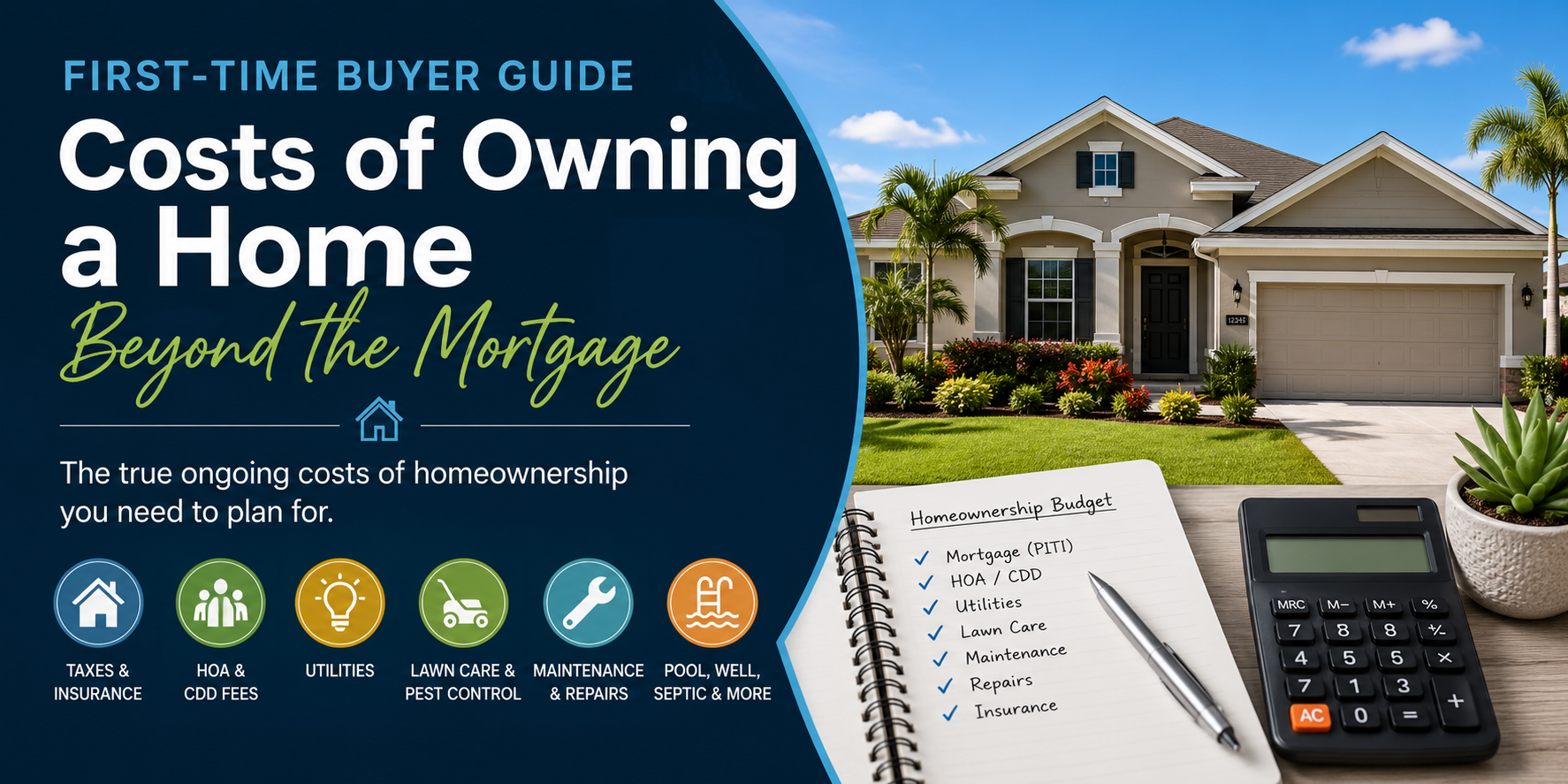
What are the true costs of owning a home beyond the mortgage payment?
For a detached single-family home, ongoing costs may include property taxes, homeowners insurance, HOA fees, utilities, lawn care, pest control, routine maintenance, repairs, and property-specific expenses such as a pool, well, or septic system. The exact amount depends on the home, its age, its condition, and the features you are responsible for maintaining.
Your Mortgage Payment Is Only the Starting Point
First-time buyers often focus on the principal and interest payment when deciding what they can afford.
And that makes sense. It is usually the biggest number.
But owning a home involves more than paying back the mortgage. You also need to account for taxes, insurance, utilities, maintenance, repairs, and all the little expenses that come with taking care of the property.
Some costs happen every month. Some happen once or twice a year. And some wait until the least convenient possible moment to introduce themselves.
So before you purchase a home, you want to understand the full monthly and yearly picture.
What Does PITI Mean?
You may hear your lender or real estate professional use the term PITI.
PITI stands for:
Principal
Interest
Taxes
Insurance
The principal is the amount of your payment that goes toward the balance you borrowed. Interest is what the lender charges for the loan.
Property taxes and homeowners insurance may be collected through an escrow account.
Your lender estimates the annual cost of the taxes and insurance, divides those amounts by 12, and includes one-twelfth in each monthly payment. The lender then uses the escrow account to pay the bills when they are due.
That means the amount coming out of your bank account each month may include more than just principal and interest.
Can Your Mortgage Payment Change?
Yes, even when you have a fixed-rate mortgage.
With a fixed-rate loan, the principal and interest portion generally remains the same. But the taxes and homeowners insurance portions can change.
If your insurance premium increases, the lender may need to collect more money for escrow. If the property tax amount changes, that can also affect your payment.
Your lender typically reviews the escrow account periodically. If there is not enough money being collected to pay the projected bills, your monthly payment may increase.
Sometimes the change is small. Sometimes it is not.
This is one reason buyers should avoid stretching their budget so tightly that any increase becomes a major financial problem. Your payment at closing is important, but you also need room for future changes.
Remember That Property Taxes May Change After the Sale
A first-time buyer should not assume that the seller’s current property tax bill will be the buyer’s future tax bill.
The amount can be affected by the property’s assessed value, exemptions, and other factors. Once the property changes ownership, the future tax amount may look different from what the seller was paying.
Your lender will provide an estimate, but it is still an estimate.
When you are comparing homes in Jacksonville, St. Augustine, Orange Park, Fleming Island, St. Johns, or another Northeast Florida community, make sure you are looking at the projected payment rather than relying only on the current owner’s expenses.
HOA and CDD Costs
The next thing to consider is whether the home is located in a homeowners association.
An HOA may charge monthly, quarterly, semiannual, or annual fees. Those fees may help maintain common areas, neighborhood entrances, amenities, roads, or other community features, depending on the association.
You need to know how much the fee is, when it is due, what it covers, and whether the association has any planned increases or special assessments.
The home may also be located within a Community Development District, commonly called a CDD.
CDD charges are generally collected as part of the property tax bill rather than paid as a separate monthly HOA fee. But they still affect the overall cost of owning the property.
A home may have an HOA, a CDD, both, or neither.
Do not assume. Ask.
Homeowners Insurance Is an Ongoing Cost
Homeowners insurance is not just something you purchase to get through closing.
It is an ongoing cost that may change from year to year.
The premium can be affected by the home itself, the type and age of the roof, the systems in the property, available coverage, deductibles, and other factors considered by the insurance company.
If the yearly premium changes, your escrow payment may change too.
Buyers should begin researching insurance costs early in the purchase process. Two similarly priced homes may have very different insurance expenses.
And when you are planning your long-term budget, you need to consider more than the first-year premium.
Utilities for a Detached Single-Family Home
Utilities are another major part of the ongoing costs of homeownership.
Depending on the property, you may be responsible for:
Electricity
Water
Sewer
Trash collection
Internet
Gas
Irrigation water
Well or septic-related electricity and maintenance
The size of the home, number of occupants, insulation, appliances, HVAC efficiency, and personal habits can all affect what you pay.
A larger home may cost more to cool. An older HVAC system may use more electricity. A pool pump, irrigation system, or well pump may add to the monthly power bill.
So when you are looking at a house, think about how the property functions, not just how much the mortgage will be.
Florida Lawn Care Can Become Its Own Category
If you purchase a detached home with a yard, you are also purchasing the responsibility for maintaining that yard.
And in Florida, grass can be a little needy.
Not every property has the same type of sod, soil, shade, drainage, or irrigation. What works in one yard may not work in another.
Your ongoing lawn costs could include:
Mowing and edging
Fertilizer
Weed control
Outdoor pest control
Irrigation repairs
Water for irrigation
Shrub and tree trimming
Mulch
Plant replacement
Leaf and debris cleanup
You may do the work yourself or hire a lawn service. Either way, there is a cost involved.
Even when you handle everything yourself, you may need a lawn mower, trimmer, blower, fertilizer, tools, fuel, and the occasional weekend you thought you were going to spend doing something else.
Indoor and Outdoor Pest Control
Pest control is another expense buyers do not always think about before purchasing a home.
You may choose to have regular indoor pest service, outdoor treatments, or both. The yard may need treatment for insects that damage grass, while the home may need prevention and monitoring for common household pests.
The right plan depends on the property, its location, and what issues are present.
This may not be one of the largest monthly costs, but it is still part of maintaining a detached home in Northeast Florida.
Routine HVAC Maintenance
Your HVAC system needs regular attention.
That includes changing filters, keeping the drain line clean, scheduling routine service, and addressing small concerns before they become larger repairs.
A basic filter may not cost much. But the ongoing maintenance still needs to be part of your schedule and budget.
Then there are the unexpected repairs.
If the air conditioner stops cooling, you are now the person responsible for getting it fixed. There is no landlord to call.
And naturally, air conditioners tend to be very aware of when it is August.
Water Heater, Plumbing, and Electrical Maintenance
A home contains systems that wear out over time.
The water heater may eventually need a repair or replacement. A faucet may start leaking. An outlet may stop working. A toilet may run continuously until you finally get tired of hearing it.
Some repairs are small. Others are not.
The age and condition of the home will influence how much you should expect to spend. A newer home may have fewer immediate needs, but no home is maintenance-free.
When you buy, review the inspection report carefully and pay attention to the ages of the major systems. That information can help you begin planning for future expenses.
Pool Ownership Adds Another Layer
A pool can be a great feature, but it comes with ongoing costs.
You may need to budget for:
Regular cleaning
Chemicals
Electricity for the pump
Filter maintenance
Equipment repairs
Water replacement
Screen enclosure maintenance
Surface repairs
Pool service
You can maintain the pool yourself or hire a service company.
Either way, make sure you understand what the pool will require before deciding whether it fits your budget and lifestyle.
A pool is wonderful when you want a pool.
It is less wonderful when you only wanted the house and the pool came along as a full-time side project.
Well and Septic System Costs
Some detached homes in Northeast Florida use a private well, a septic system, or both.
A well may require water testing, filtration maintenance, pump repairs, treatment equipment, or other service depending on the system and water quality.
A septic system needs proper use and periodic pumping. The timing will depend on the size of the tank, the number of people in the home, and how the system is used.
These costs may not happen monthly, but they still need to be included in your long-term planning.
When you are considering a property with a well or septic system, find out what equipment is present, what maintenance has been completed, and what the system may need going forward.
Dryer Vents, Gutters, Trees, and the Less Exciting Stuff
Some home maintenance costs are easy to overlook because they are not part of a major system.
You may need to clean the dryer vent, clear gutters, pressure wash exterior surfaces, trim trees away from the roof, reseal areas around windows, or address drainage around the home.
None of those things sound especially exciting.
But ignoring small maintenance items can sometimes lead to much more expensive repairs later.
Homeownership involves taking care of the visible things and the things you rarely think about until they stop working.
Repairs and Replacements Will Happen
At some point, something is going to break.
That is not a negative statement. It is just the reality of owning a home.
An appliance may stop working. A plumbing repair may come up. The HVAC system may need service. A roof may need repair years down the road.
First-time buyers should plan for maintenance and repairs from the beginning rather than treating every expense as a surprise.
You do not need to know exactly what will break or when. You just need to have room in your budget for the fact that something eventually will.
Creating a dedicated home maintenance savings account can make these costs easier to manage when they come up.
Upgrades Are Different From Repairs
There is also a difference between maintaining the home and improving it.
A broken water heater is a repair.
New countertops because you do not like the current ones are an upgrade.
Both cost money, but one is usually necessary while the other may be optional.
First-time buyers often move in with a list of projects they want to complete. That is fine, but give yourself time to live in the home and understand its real needs before spending every dollar on cosmetic changes.
The house may have a different list waiting for you.
Special Assessments Can Add Unexpected Costs
If the home is part of an HOA, the association may sometimes approve a special assessment for a project or expense that is not fully covered by its regular budget.
Special assessments are not part of every community, and they are not guaranteed to happen.
But buyers should review the available association documents, budgets, meeting information, and disclosures so they understand what may already be planned or discussed.
Knowing about a possible expense before purchasing is much better than learning about it after moving in.
How Much Should a First-Time Buyer Budget?
There is no single number that works for every home.
A newer home with a small yard, no pool, no HOA, and updated systems will have different ongoing costs than an older home with a large lawn, pool, septic system, and aging HVAC unit.
The right budget depends on:
The home’s age
The condition of its systems
The size of the property
HOA and CDD obligations
The type of utilities
Whether it has a pool
Whether it uses well or septic
The amount of yard maintenance
Your plans for repairs and upgrades
This is why the inspection, insurance research, association documents, and property details all matter.
You are not just deciding whether you can buy the home.
You are deciding whether you can comfortably own it.
The Final Takeaway
The costs of owning a home beyond the mortgage will be different for every property.
For a detached single-family home, you need to consider taxes, insurance, HOA or CDD expenses, utilities, lawn care, pest control, routine maintenance, repairs, and any property-specific systems such as a pool, well, or septic tank.
The goal is not to make homeownership sound overwhelming. It is to help you walk into it prepared.
Getting ready to purchase your first home in Jacksonville or Northeast Florida? Give CrossView Realty a call at 904-503-0672 to start your home search and talk through the full cost of owning the properties you are considering. You can also email us at info@crossviewrealty.com or visit CrossView Realty. We’d love to help.
Frequently Asked Questions
Q: What are the main costs of owning a home beyond the mortgage?
A: Common ongoing costs include property taxes, homeowners insurance, utilities, HOA fees, lawn care, pest control, routine maintenance, and repairs. A pool, well, septic system, or large yard can add more property-specific expenses.
Q: Why can my mortgage payment change if I have a fixed interest rate?
A: The principal and interest portion of a fixed-rate mortgage generally stays the same, but property taxes and homeowners insurance can change. If those expenses are paid through escrow, the lender may adjust the monthly payment to collect the amount needed.
Q: Are HOA and CDD fees included in the mortgage payment?
A: HOA fees are usually paid separately based on the association’s schedule. CDD charges are generally included on the property tax bill, so they may be collected through escrow when the lender handles the buyer’s taxes.
Q: How much should a first-time buyer save for home repairs?
A: There is no perfect amount for every property. The age of the roof, HVAC, appliances, water heater, plumbing, and other systems should help guide the budget. Buyers should maintain an emergency fund rather than assuming no repairs will be needed during the first year.
Q: What ongoing costs should I expect with a detached home in Jacksonville?
A: In addition to the mortgage, taxes, and insurance, you may have electricity, water, sewer, lawn service, pest control, HVAC maintenance, irrigation expenses, and HOA or CDD costs. Homes with pools, wells, septic systems, or larger yards may require additional maintenance.