Should I Get a Whole Home Generator in Florida? What Jacksonville Area Homeowners Need to Know
Should you get a whole home generator if you live in Northeast Florida?
For homeowners in Jacksonville, St. Johns County, Clay County, and the surrounding areas, a whole home generator is one of the most practical investments you can make. Florida's hurricane season runs June through November — and when a major storm tracks through our region, extended power outages aren't a possibility. They're a pattern. Here's everything you need to know to make an informed decision.
Why This Question Matters More in Northeast Florida
If you've lived in Jacksonville, Orange Park, Fleming Island, Nocatee, St. Augustine, or Ponte Vedra Beach for more than a few years, you've already felt a storm take your power out. Maybe it was a few hours. Maybe it was a few days. Northeast Florida sits in a corridor where even storms that make landfall farther south — on the Gulf Coast or Central Florida — still push tropical-force winds, heavy rain, and downed lines across Duval, Clay, and St. Johns County.
Hurricane Irma in 2017 left millions of Floridians without power for days. Hurricane Milton in 2024 knocked out electricity to more than 3 million customers across the state. When outages stretch past 24 hours, the conversation shifts quickly — the food in the refrigerator, the medications that need to stay cold, the family members who depend on powered medical equipment, the Florida heat that makes an unventilated house genuinely dangerous in summer.
A whole home generator doesn't just keep the lights on. In this climate, it keeps things livable.
What a Whole Home Generator Actually Is
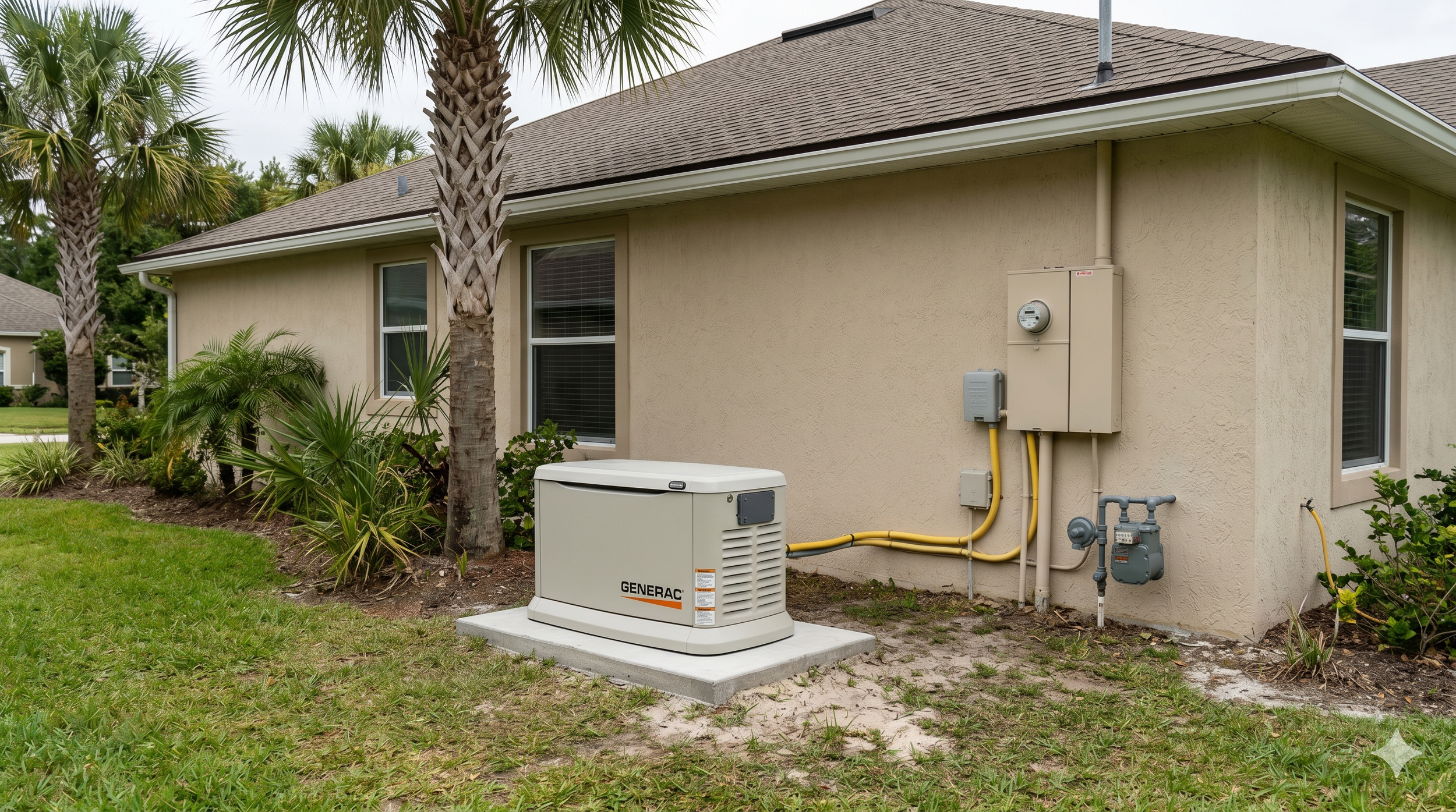
A whole home standby generator is a permanently installed unit that sits outside your house — typically on a concrete pad — and connects directly to your electrical panel. When utility power goes out, an automatic transfer switch (ATS) detects the outage and kicks the generator on within seconds. Your home transitions to generator power automatically. No manual startup, no extension cords, no going outside in the rain.
Most standby generators run on natural gas or liquid propane. If your home has a natural gas line, the generator connects directly to it — which means it can run as long as the gas supply holds, essentially indefinitely during most storm scenarios. All-electric homes can still have a standby generator; they'll just need a propane tank installed at the same time.
This is the fundamental difference between a standby generator and a portable one. A portable unit requires manual startup, runs on gasoline that you have to store (and that degrades over time), and typically can only power a few circuits through extension cords. A standby generator is fully integrated into your home and requires nothing from you when the lights go out.
Types of Whole Home Generators
Not all standby generators are the same. Understanding the options helps you match the right system to your home and your needs.
Air-Cooled Generators (7–20 kW) These are the most common choice for residential use in Northeast Florida. They use an air-cooled engine, similar to a lawn mower or small engine, and are well suited for homes up to about 2,500 square feet. They're compact, relatively affordable to install, and handle the basics well — air conditioning, refrigerator, lights, outlets, and well pump if applicable.
Liquid-Cooled Generators (20 kW and above) Larger homes, homes with higher electrical loads, or homeowners who want more seamless power capacity should look at liquid-cooled units. These use a radiator-style cooling system similar to a car engine, which allows them to handle sustained heavy loads more efficiently and quietly. They're a larger upfront investment but are the right choice for homes over 2,500 square feet or households that want true whole-home coverage without managing load.
Fuel Options: Natural Gas vs. Propane Natural gas is the preferred option when it's available — it's connected to the utility line, so there's no tank to monitor or refill. Propane is a strong alternative for homes in St. Johns County, Clay County, or rural areas of Duval County where natural gas lines don't run. Propane has an indefinite shelf life and doesn't degrade like gasoline, but tank size determines how long you can run, so sizing matters.
Top Brands Worth Knowing
The standby generator market is well-established. Three brands consistently lead for residential use:
Generac is the most widely installed brand in the country and has strong dealer support throughout Northeast Florida. They offer a wide range of sizes and are available through most electrical and HVAC contractors in the Jacksonville metro area.
Kohler is known for being among the quietest standby generators on the market, which matters when a unit runs for days in a residential neighborhood. They're highly regarded for reliability and longevity.
Champion offers competitive pricing for air-cooled residential units and has gained a strong reputation in the Florida market, particularly for mid-size homes looking for solid performance without the premium price point.
All three brands have authorized dealers and service providers in the Northeast Florida area. When comparing quotes, make sure you're comparing the same kW output and fuel configuration — not just the sticker price.
What a Whole Home Generator Does — and What It Doesn't
This is where a lot of buyers have unrealistic expectations, and it's worth being direct about.
A properly sized whole home generator keeps your house running during a power outage. Air conditioning, refrigerator, lights, outlets, Wi-Fi, sump pump, well pump — all of it. For most homes, it feels close to normal.
But there are real limitations.
Generator capacity is finite. The generator has a maximum output measured in kilowatts. If you simultaneously run the central AC, the electric water heater, the electric dryer, the oven, and every other high-draw appliance at once, you can exceed that capacity. The generator doesn't distinguish between what's essential and what isn't — it just tracks the load. Exceeding it will cause the unit to shut down to protect itself.
Sizing determines performance. A 10 kW generator on a 3,000-square-foot home with two AC units and an electric water heater is undersized. You'll have to manage your usage. A properly sized unit — one that was calculated based on your home's actual electrical load — performs much better. This is why having a licensed electrician do a load calculation before you purchase matters.
Electric ranges, dryers, and water heaters are heavy draws. These are the appliances most likely to strain a generator that isn't sized for them. Homes with gas appliances for cooking and water heating are actually better positioned on generator performance than all-electric homes, because the heavy-draw items are off the generator's plate.
A generator is not surge protection. Lightning strikes and power surges coming off the grid are a separate problem. A whole home surge protector installed at your panel is a different device and a different layer of protection. You need both.
Where It Gets Installed and Why Location Matters
Placement follows a few rules. The unit needs to sit on a stable, level surface — almost always a concrete pad poured specifically for it. It needs to be a certain distance from windows, doors, and vents to prevent carbon monoxide from entering the home. It needs to be reasonably close to both the gas line and the electrical panel to minimize installation cost and complexity.
In most Northeast Florida homes, that means a side yard or back yard position, typically within 5 to 10 feet of the exterior wall where the panel is located. A licensed electrician and a plumber work together on the installation — the electrician handles the transfer switch and panel connections; the plumber handles the gas line. Local permits are required in Duval, Clay, and St. Johns County, and your installer should pull those on your behalf.
Flood-prone properties in coastal areas of Jacksonville Beach, Neptune Beach, or low-lying parts of St. Johns and Clay County may require the generator to be elevated above the base flood elevation. This is worth discussing with your installer before any concrete work is done.
What Maintenance Actually Looks Like
A standby generator is not a set-it-and-forget-it investment. It needs consistent care to be reliable when you need it most.
Weekly exercise cycle. Most modern standby generators run an automatic self-test once a week — typically 15 to 20 minutes of operation under light load. This keeps the engine lubricated, charges the battery, and circulates fluids so nothing sits stagnant. You should periodically step outside during the scheduled run time and listen for it. If it isn't cycling, something needs attention.
Oil and filter changes. Plan for an oil change every 100 hours of operation or annually, whichever comes first. After a storm that runs the generator for multiple days straight, check the oil before the next extended run.
Air filter. Florida's humidity, pollen, and heat can clog filters faster than you'd expect. Check every six months and replace if needed.
Battery. The starting battery needs periodic inspection and replacement as it ages. A dead battery means the automatic start fails when you need it most.
Annual professional service. Most generator owners in Northeast Florida benefit from a service contract with a local provider. A professional annual inspection covers everything a homeowner might miss — fuel system checks, voltage calibration, spark plugs, belt and hose condition, and rodent damage checks, which are more common than people expect in our climate.
A good rule of thumb: get your generator serviced in April or May, before hurricane season. Don't wait until a storm is in the forecast — every service provider in Northeast Florida is booked solid when that happens.
Is It Worth It?
For most homeowners in Northeast Florida, yes. The combination of an active hurricane season, a subtropical climate that makes heat during outages genuinely dangerous, and the reality that our area gets impacted by storms that form far away makes backup power more of a practical need than a luxury.
The total installed cost for a standby generator in Florida varies, but a mid-range 13–20 kW system professionally installed typically runs between $8,500 and $12,000 depending on fuel type, panel work required, and site conditions. Smaller systems come in lower; larger liquid-cooled systems come in higher.
It's also worth knowing that a standby generator can add value to a home. Buyers in Northeast Florida increasingly ask about generators — and in a market where hurricane preparedness is part of every home-buying conversation, it's a feature that stands out.
If you're buying or selling a home in Jacksonville, Ponte Vedra Beach, Fleming Island, St. Johns, Green Cove Springs, Middleburg, or anywhere across Northeast Florida, CrossView Realty can help you navigate what features matter in this market — generators included.
Give us a call at 904-503-0672, reach us at info@crossviewrealty.com, or visit crossviewrealty.com to connect with our team.
Frequently Asked Questions
Q: Should I get a whole home generator in Jacksonville, FL? For most homeowners in the Jacksonville area, a whole home standby generator is a smart investment. Northeast Florida experiences tropical storms and hurricane impacts on a regular basis, and extended power outages are a real risk every season. A standby generator keeps your home livable — air conditioning, refrigerator, and essential circuits running — without any manual effort during an outage.
Q: What size whole home generator do I need for a Florida home? Generator sizing depends on your home's square footage and electrical load. A 10–15 kW unit generally covers homes up to about 1,500 square feet with standard appliances. Homes between 2,000 and 2,500 square feet typically need a 16–22 kW system. Larger homes or homes with higher electrical loads — multiple AC units, electric water heaters — may need 22 kW or more. A licensed electrician should do a load calculation before you purchase to size correctly.
Q: Can a whole home generator run my central air conditioning in Florida? Yes — but the generator needs to be properly sized for it. Central AC is one of the highest-draw appliances in a Florida home, especially at startup. If your generator is undersized for your home's total load, running the AC simultaneously with other heavy appliances can overload the unit. A correctly sized standby generator handles AC without issue.
Q: How often does a whole home generator need maintenance in Florida? Standby generators need an oil and filter change every 100 hours of operation or annually, whichever comes first. The air filter should be checked every six months — Florida's heat and humidity accelerate wear. Most modern units run a weekly automatic exercise cycle to stay lubricated and charged. A professional annual service in April or May — before hurricane season — is the best way to make sure everything is ready when you need it.
Q: Does a whole home generator add value to a home in Northeast Florida? A standby generator is an increasingly attractive feature for buyers in Jacksonville, St. Johns County, and Clay County, where hurricane preparedness is part of every home-buying conversation. While specific value increases vary, generators are a differentiator in listings and are frequently asked about by buyers, especially during active hurricane seasons. CrossView Realty can help you understand how features like generators factor into pricing and buyer interest in our local market.